

Heather Bailie lives in Huntsville and commutes to Bracebridge for work.
Last March she purchased an electric vehicle, a Chevy Bolt, to help her save on the mounting cost of gas during her commute. She says she loves her vehicle, it’s the infrastructure to service her vehicle that’s been a problem for her.
“There are two charging stations for non-Tesla cars at Harveys in Huntsville. One of them has never functioned as far as I know. I got my car in March and it wasn’t working then. There’s only been the one that has been working and that one, the only one, stopped working in the end of May, early June.”
Bailie said the two stations belong to the Ivy Network and she’s been unable to get an answer from the company. She also said when the only non-Tesla station in Huntsville was working, the app, which tells her when the station is available, didn’t seem to be working right because she would go and it would be occupied. She has had to go out of her way and travel to Gravenhurst in order to charge her vehicle which isn’t ideal.
She said she can’t use the Tesla chargers at the Huntsville Place Mall because they have proprietary nozzles, although Tesla drivers can use Ivy chargers because Ivy has nozzles for both. “I do actually have an adapter for a Tesla station but it doesn’t work for the supercharger stations which are the ones that are everywhere,” she explained.
Stepaen Little lives in Novar and also drives a Bolt, unlike Bailie who rents, he finally put in a charging station at home to avoid the hassles. He and his wife Laurie Clarke bought an electric vehicle last January. Little said they appreciated the savings in gas but trying to charge the vehicle became a pain. “Huntsville only has the one level 2 charger and that’s it, that’s all we have,” he said.
They have since also purchased a Tesla, which is easier to charge since there are eight superchargers at the Huntsville Place Mall, and according to Little, it takes about 20 to 25 minutes to get a full charge. They’ve also installed a charger at home. Before that, Little said he was unable to charge his vehicle at home enough to enable him to replenish the amount of charge needed to operate during the day. “I would get home at like 5 o’clock, plug it in, and unplug it the next morning… so you’ve got 13 hours of charging. I couldn’t replenish the 120km that it takes me to drive in a day.”
He said he would’ve bought a Tesla before the Chevy “but the Teslas were $75,000 at the time and upwards and they came down to $55,000 this summer and then we got another (Federal government) rebate and another Tesla rebate so they were reasonably priced compared to what they were a year ago,” said Little. He figures in two years they’ll get a return on their investment between what it costs to charge the Tesla versus the cost of gas. He said he was spending about $500 per month on fuel and now it costs him approximately $50.
Charger levels represent the amps of the chargers and speed of charge with level 1 being the lowest.
Doppler reached out to the Ivy Charging Network and on October 3, 2023, received the following response from Michael Kitchen, General Manager of Ivy: “We apologize for the extended period that the Huntsville chargers have been down. The Ivy chargers at Huntsville are scheduled for replacement and are expected to be back in service by end of this week.”
In May 2023, Lakeland Networks announced that it would be installing 40 new Electric Vehicle (EV) stations in the region. Doppler reached out to Lakeland Networks to find out if the project is still a go.
“Our project is very much still a go. We are actively working on this and are at early stages of construction. All major equipment has been ordered and we will complete some of the civil work this fall,” according to Peter Ewald, Manager for Lakeland Solutions.
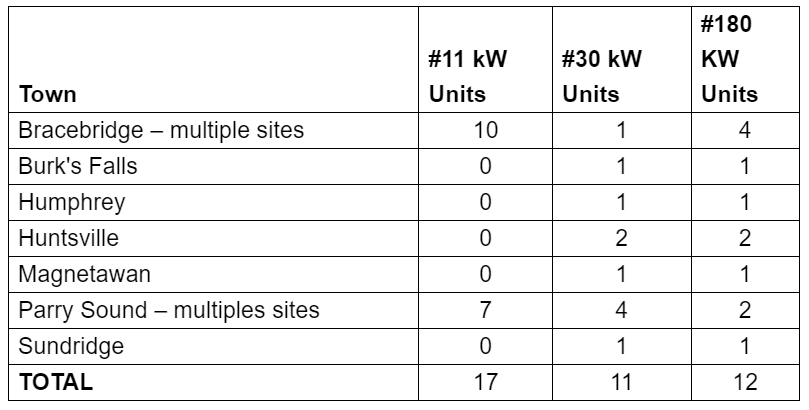
Ewald said there will be various levels of chargers. “To summarize we will have 17 Level 2 units rated at 11kW each, 11 Level 3 (DCFC) rated at 30 kW each, and 12 Level 3 (DCFC) rated at 180 kW each – these 180 kW units can also charge 2 cars simultaneously at 90 kW,” he wrote via email correspondence.
See the breakdown below:
Ewald said Lakeland is expecting to have the charger sites fully operational by fall of 2024. “That said we will bring online sites as quickly as possible based on delivery of equipment, so some sites may be operational sooner.”
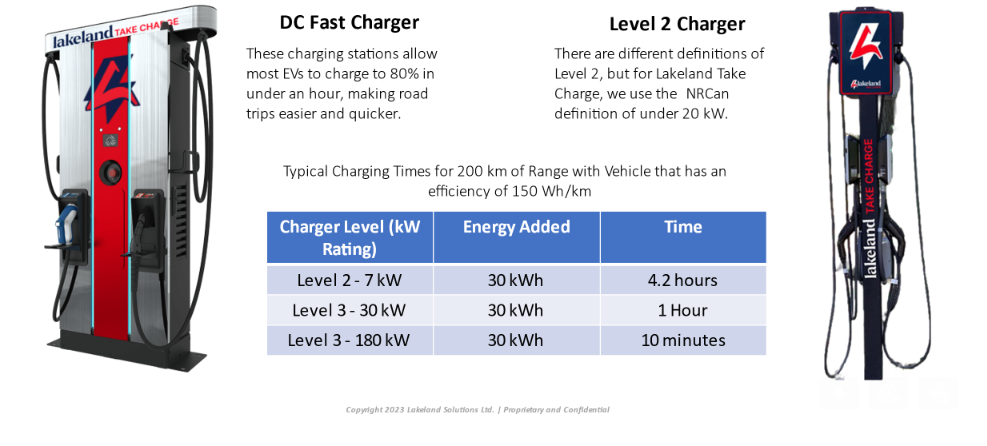
He said the chargers will work on all electric vehicles. “Our chargers will have industry standard connectors such as J1772 for the Level 2 and CCS for the Level 3. For any car that has a proprietary connector – such as Tesla(NACS), drives can carry adaptors (and most do) to ensure they can charge at these stations. We are also investigating the options to have adaptors on site and available for drivers in case they don’t have their own adaptors. As the industry grows and connector types evolve, we can upgrade our cables to match. For example, we are already working with the Charger manufacturer to get the NACS connector on our chargers.”
“Lakeland is constantly looking for creative ways to power your future with renewable sources while providing infrastructure to charge your electric vehicle,” noted Vince Kulchycki, Chief Operating Officer for Lakeland Holdings Ltd.
“EVs are coming, and Lakeland is ready to support this demand and provide a local and reliable source of charging infrastructure,” added Ewald.
Don’t miss out on Doppler!
Sign up here to receive our email digest with links to our most recent stories.
Local news in your inbox so you don’t miss anything!
Click here to support local news
We bought our own charger and an electrician to install it, when we bought the car. But mr tapley is correct you can charge it with the 3 prong cord that the car comes with so it shouldnt be a problem. The rest of the questions are in my sons perview, but we only have 125 amp service atm and we can use ours with no problem. We only charge at night after 7 pm. Oh yes and there is an app for your phone that will show all the public chargers and the cost to use them. Again my son knows, the name etc of it. I do know there is a level 3 at the airport.
Brian,
Here is the number for Lakeland Networks: (705) 646-1846
Clue me in, make it simple, I’m a business owner in the country, not in town. I do get quite a few vehicles in and out on a normal basis, more and more of them electric.
So far these vehicles charge by just plugging into a normal weatherproof three prong, 15 amp, 120 volt outlet. It takes a while but it works.
So, if I wanted to install a faster charger, say a level 2 or 3, three questions immediately are of concern.
1 Who do I talk to about purchase and installation?
2 How big a power supply do I need to install, over and above the cost of the charger, to supply it?
3 Ballpark, what would this charger cost me?
Give me some facts in your reporting.
Also, I assume if I put in such a charger, I get to choose how much per kwh the customer pays me to use it. I can set the price and the charger will not work without a credit card payment device as part of it. You cannot expect me to provide free energy and I cannot “staff” such a device. These are not options and at the end of the day, this thing, like any business venture must make me some profit. Everybody else along this electric bandwagon seems to be making a profit and I feel no different.
The sooner I can see these kind of numbers and calculate costs and potential profits, the sooner I’ll install a charger.
Em Arde:
The infrastructure was in place when I bought my car. I CANNOT install a home charger because, as the article states, I do not own my home. There is no entitlement. After 5 months of no help from the charging network, I contacted local media for help. How exactly am I entitled?
So, let me get this straight: These people bought EVs before there was sufficient public charging infrastructure; and they didn’t (initially, at least) want to get their own chargers; and then they whined and complained that there wasn’t sufficient public infrastructure? The rampant sense of entitlement people have these days knows no bounds.
Sandy, to be fair, you omitted this: “That said we will bring online sites as quickly as possible based on delivery of equipment, so some sites may be operational sooner.”
“expecting to have the charger sites fully operational by fall of 2024”
That’s a way down the road. Doesn’t exactly jive with: “EVs are coming, and Lakeland is ready to support this demand and provide a local and reliable source of charging infrastructure,”
Ontario is behind. In Quebec, charging spots are common, noticeable even if I don’t have an electric vehicle.