
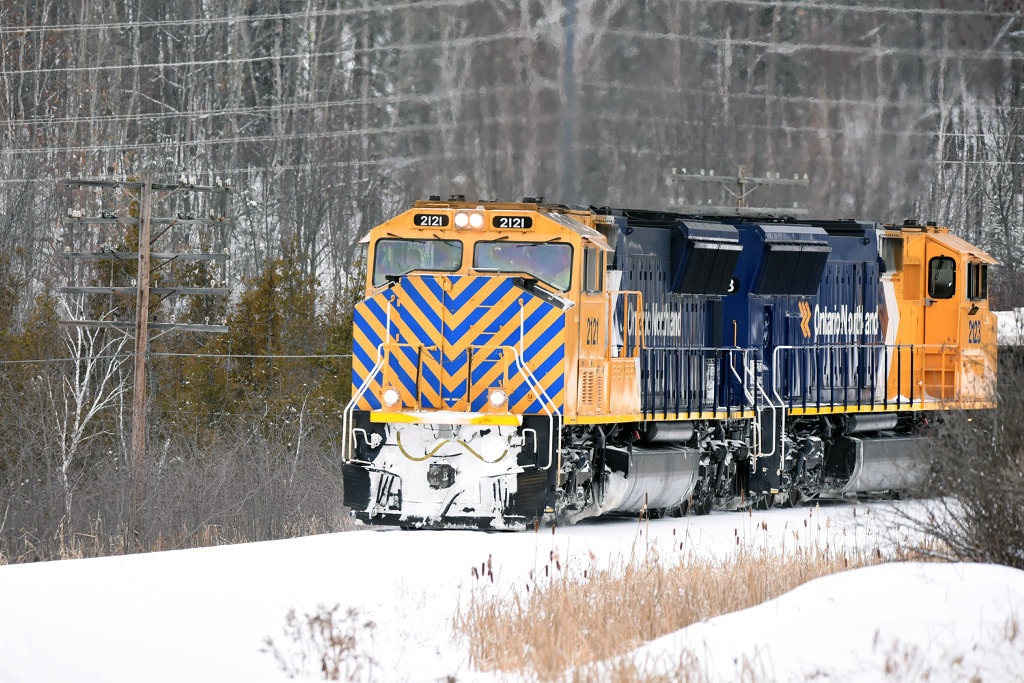
I don’t know how my great-great-grandfather, Matthew Markle, might have felt about the railroad coming to Huntsville. He was in Utterson in 1868 and moved north in 1869. The Colonization Road already cut across his lot in Chaffey; “it passed between the house and barn” on its way into the growing community.
He would have known the train was coming. When the Northern P J Rwy. paid for a right of way through Lot 9, Conc. 1, Chaffey Twp., that transit lopped the waterfront from the old farmstead. Would he have felt a sense of loss? Could he have found solace in the tune by Curtis Mayfield? “People get Ready. There’s a train a Comin’.” Matthew was gone in 1884. They were working on the railroad in 1885, and the first train arrived in Huntsville in 1886.
My grandfather told me his father, Asaph or ‘Ace,’ drove cadge and coach wagons along Muskoka roads before the railroad arrived. After that, Ace and his wagon delivered what the railroad brought. Lots of the old homes in Huntsville never had driveways. No car. No Horse. Anything they had brought in by rail or bought downtown could be delivered. Maybe by my great-grandfather.
In the 1926 booklet, ‘Huntsville’s Old Home Week,’ there is a depiction of the first Grand Trunk Railway engine to reach Huntsville. It shows a steam engine with a couple of baggage or freight cars and a passenger car stopped beside the station. The railroad brought more tonnage of freight, which could be delivered cheaper than cadge wagons and steamers could. Passengers would now have a more comfortable journey to the community. The haul over local roads must have been tiresome, back-breaking, boulder-strewn and muddy, and often involved going through countryside fires as settlers burned the timber to clear the land.
Huntsville: With Spirit and Resolve is the Susan Pryke history of early Huntsville. In it, you find a picture of an engine stopped at the Huntsville Station. That is the first station in Huntsville, but not the first train. It would have been great if someone had a photo of that first train, but as far as I know, there isn’t one.
Once here, the railroad built a lot of spur lines and sidings. There had been one near us on South Lancelot Rd., and further along at Martin’s Siding. There was also one built for the Bethune Pulp and Lumber Company for their mill at Lot 1, Conc. 1, Chaffey Township. The property had been the farm of the Mawhiney family. Most lumber companies were serviced by sections of purpose-built track.
Those spurs were purpose-built parking lots. A flat car could be shunted into such a site and left over the winter. Locals would contract to cut and load Hemlock tan bark for sale to the local tannery. In the early days, that would have been the one owned by Shaw-Cassils. Hemlock was plentiful, and though the wood itself was frowned upon, most of us have had the job of making alterations to buildings where hemlock was the lumber of choice. It never gives up a nail without a fight.
Just up the road from where we now live is a long, open stretch of track that runs along the Bliss farm. A long, flat section of track, the edge of open fields with a good stretch of geese in the fall and ideal for train watching in the winter. If you want to see the lower half of a train wrapped in a cloud of swirling snow, that’s a good spot to set up your camera. Many have. You just need to know when the train‘s coming and if it has snowed. I never said it was easy!
I admire the theory and notes of Aldo Leopold. Writing that he admired trains for their modesty and focus on purpose. He compared freight trains, coffee pots and owls. Accusing them all of rising too early.
Back in the day, trains ran to pretty tight schedules. Mr. S.R. Davis was employed by the Post Office from 1941 to 1961, including serving as Postmaster for a good number of years. In his notes, he wrote that trains No. 41 and No. 44, one from the North and one from the South, rolled into town about one or two in the afternoon. Morning trains, numbers 47 and 46, were usually in time for the mail to be sorted and in private boxes by 8 a.m.
But sometimes there were forces greater than, and immune to, any sort of schedule. In the report of Mr. Davis to his uncle, R.B. Whiteside of Duluth, Minnesota, there is an apology. Because the daily report from the Bethune Pulp and Lumber Company to Mr. Whiteside had been late. On March 31, 1926, the Huntsville area suffered the worst storm in 50 years. Sorry, uncle, but “the wires are all down.” The report went out, though. In a mailbag. By train. The train wasn’t as fast as the telegraph, but the report was delivered.
There was and is again our local contribution to the aura and legend of rail. The Portage Flyer chugged and whistled its way through the years. From 1904 to 1959, the ‘Flyer’ covered the mile and an eighth between North and South Portage. A ‘Flyer’ in name only. The train still operates as an attraction in Muskoka Heritage Place. It’s a great train to be on when it makes its Christmas Special run.
In the lyrics of a plethora of songs, trains run front and center. There is a great deal of lore and legend recorded there. The romance of the railroad and its ribbon of steel. The song is often about someone getting out of town. How about Hank Snow and his ‘I’m Movin’ On’? Or you can cue up ‘Train! Train!’ by Blackfoot. Some A1 harmonica here, soundscape for old steam power.
Or they could be getting back from somewhere. Who else but Gordon Lightfoot would spin ‘Steel Rail Blues’, telling us the “big steel rail gonna carry me home to the one I love.” Railroad music, can’t ignore the ‘Canadian Railroad Trilogy’ about the building of that ribbon of steel. Where it says, “We got to lay down the track and tear up the trails,” which they did, and that tied the Atlantic to the Pacific.
Locally, we can give a nod to Lucille Frith, who worked tirelessly toward getting the train back. Thank you, Lucille. And accolades to the volunteers who put the old station back in shape. No thanks to a mayor and council who spent a lot to repair the building’s drainage. Then just turned and sold it for a toonie.
So, the return of rail travel to Muskoka and the north has pretty big boots to fill. I think most people will wish it well. And if you listen, can you “hear that train a comin’?’ ‘It’s rolling round the bend,’ a la Johnny Cash.
Big boots indeed! High expectation.

Allen Markle was born in Huntsville and lived on Brunel Rd. Around Forbes’ corner, up Carter’s hill, and he was home. He says his dad kept him busy working for many of Huntsville’s Italian families and main street businesses, and doing construction for lodges and cottagers on Lake of Bays.
He spent a couple of years in the south, but eventually returned to the Huntsville area in 1967. Spent 10 years in the employ of Wiik and Hoeglund and another 27 at Kimberly-Clark.
“I enjoy woodworking and have fished and hunted for many years. Still spend a lot of time regaling my family and anyone who’ll listen about how it was ‘back in the day,’ he says.
Don’t miss out on Doppler!
Sign up here to receive our email digest with links to our most recent stories.
Local news in your inbox so you don’t miss anything!
Click here to support local news
Thanks for an excellent story to ponder. I arrived in Jasper on Via 1, 9 hours “behind schedule” yesterday. The trip from Toronto was spectacular in so many ways. The people (from all over the world), the sights (so vast & varied), the sounds (the human lyric blend with mechanical machine) the feelings (the constant nudge by the sway & bump on iron) packaged into 1 – priceless.
“One wish: that the Huntsville station may yet be restored to its historical function; further, that it serve as the attractive, full-feature transportation hub for the exploration of our area.” !
Looking forward to the return of the Northlander. Support it. Use it. The people will come!
I hope the return of the trains can make a go of it. I do plan on using it. Hope others will also.
I lived near the CNR route in Stirling Ontario just north of Belleville. My dad bought me the last ticket on the last passenger train out of Stirling. Many memories of those steam engines.
I particularly loved this paragraph.
“I admire the theory and notes of Aldo Leopold. Writing that he admired trains for their modesty and focus on purpose. He compared freight trains, coffee pots and owls. Accusing them all of rising too early.”
Thank you Allen; great to reminisce about the beloved train. Trains of the bygone era have their deficiencies of course but it’s the romance and wonder of travelling on them that wakens the imagination. I am so looking forward to buying my first ticket (online of course) to catch a ride. I don’t even really care where it goes! Lucille and the Society have worked tirelessly and I’m grateful for their efforts. I echo John’s wish that the old station can be resurrected for the purpose it was intended. I already see Val’s historical map front and centre on the station wall. Let it be so! Allan, your piece connects us through our memories and I hope you will contribute again in the op-ed section.
Thanks, Allen, for your wonderful column on trails and railroads in Muskoka. Deep history and insight. So much gratitude for the train’s return is owed to the persistence of Lucille Frith and her colleagues along the line.
One wish: that the Huntsville station may yet be restored to its historical function; further, that it serve as the attractive, full-feature transportation hub for the exploration of our area.
A great post, Mr. Markle. Thank you. I hope you’ll become a regular contributor. I always look for your posts in the comments section.
Thanks for this “0de to the train” history! Now we only romanticize about train travel – long for it, wait for it!
I also want to thank Lucille Frith and the train station society for their work and dedication. At the time of their restoration we found a map in our attic of early train routes from 1896 that we donated. We lived across the road from the station at the time.
To continue on the music theme “those were the days my friend” sang by Mary Hopkin!
Thanks for this wonderful history lesson! Who doesn’t love a train?
Great article and stroll through the years. Thanks
” The train kept a rolling all night long “…..The Yard Birds !
What I love about this piece is that it reminds us change has always felt disruptive in the moment. The railway cut through farms, altered shorelines, replaced wagons, and reshaped how people worked and moved. I’m sure it felt like loss to some and opportunity to others. Probably both at the same time.
Looking back, it’s easy to romanticize the steam engine and forget the mud, the fires, the uncertainty. But communities adapt. They always have. The train did not erase Huntsville. It helped redefine it.
As rail returns in a new form, maybe the question isn’t whether it perfectly recreates the past, but whether we’re willing to do what earlier generations did: adjust, build around it, and make it serve the community.
History suggests we’re capable of that.