
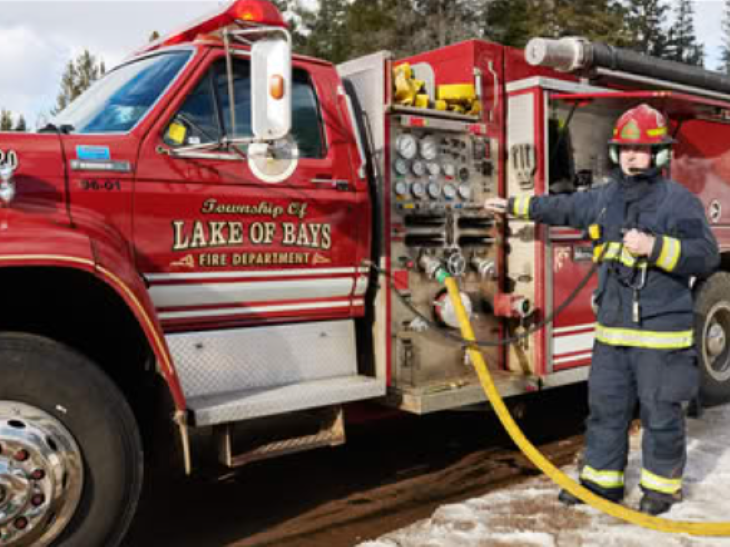
Jeremy Alldred-Hughes, Director of Emergency Services/Fire Chief, was before Lake of Bays Council at its May 12 meeting, asking for permission to transfer and repurpose a surplus truck from the Port Cunnington Fire Station to be stored at the Hillside/Interlaken Fire Station.
The recommendation also included establishing an auxiliary team to support fire rescue operations.
“One of the things that we’ve always done in the past when we fight a structure fire is we have to shuttle air cylinders back and forth from the fire scene to fill them so that we can continue to operate,” said Alldred-Hughes, adding that the fire department has 70 air cylinders in service. He said from an operational standpoint, the fire department generally has to fill 15 to 20 cylinders to fight a full structure fire. The cylinders power the Self-Contained Breathing Apparatus (SCBA) that firefighters use while battling a fire.
“Currently, we’re shuttling these cylinders to Huntsville to fill on a bigger cascade system,” said Alldred-Hughes. He said purchasing more cylinders has been considered, but through discussions, it was decided that having a mobile air system filler would be more effective and safer.
He said the surplus auxiliary truck at the Port Cunnington station could be repurposed. It could carry additional equipment, including extra forestry equipment, hazmat equipment, rehab equipment, and
medical equipment, and serve as an air-filling station capable of filling 20 to 25 cylinders on scene.
He said the truck would be housed at the Interlaken Fire Station 50, and the fire department will reach out to members of the community to form an auxiliary team. “Auxiliary responders will have basic training on first aid, rehab, and support roles, but not firefighting. This will allow for a more flexible staffing and operational guidance for seasonal members,” noted Alldred-Hughes in his report to council.
“After 6 months and 1 year a report will be brought back to council outlining the successes of
the unit along with the calls it attended, trainings and return on the investment,” he added.
The cost of the air cascade system is estimated at $14,000 to be funded from the Township’s regular operations budget, added Alldred-Hughes.
“Speaking with our neighbours, we would be the only fire service that has a vehicle with these capabilities, so Algonquin Highlands would be leaning on us to respond with that vehicle to fill air cylinders for them in structure fires, as well as Huntsville, Bracebridge, with the agreement that once we’re done they would allow us to refill our system at one of their halls before returning.” Alldred-Hughes said because the municipality already has the vehicle, it would be a small investment to get the pilot off the ground.
Lake of Bays Councillor Rick Brooks was supportive of the initiative and called it out-of-the-box thinking. Councillor George Anderson also spoke in favour of the initiative and asked if the auxiliary members would be volunteers or whether they would be paid positions. Alldred-Hughes said it would be a “paid volunteer position, or a paid on-call position,” just like firefighters.
In the end, council approved the pilot.
You can find the report HERE (PDF).
Don’t miss out on Doppler!
Sign up here to receive our email digest with links to our most recent stories.
Local news in your inbox so you don’t miss anything!
Click here to support local news
How is it that we have to spend a third of a million dollars on new fire trucks after a specified number of years because they are “too old to be reliable” and yet we have this “surplus truck” sitting around? If it was too old that we had to replace it what is it still doing here in the first place? If it was actually still serviceable (my guess) then why did we spend the vast amount on the new truck? We are short of volunteers needed to run these trucks at the moment anyway.
How does a pumper truck that is designed to carry and pump water manage to suddenly be a capable vehicle on which to somehow mount high pressure air compressing equipment used to fill air cylinders? The modifications would seem to be huge!
This story is muddled and not clear. There should be better reasoning explaining this.
I was a fireman when we got our first air packs, thinking back they were not that useful as we only had two packs and 4 cylinders per truck but it was a first step. We used to fill them at the Tally Ho hall I think.
If what we need is a method of filling tanks and transporting them, a small pickup truck would fit that task and the township has a whole lot of them running around most days looking for potholes and carrying building inspectors to and from sites. Could these do this job and we sell the old fire truck to help pay costs?
I’m confused by this story and the logic behind it. As a matter of fact I thought the department gave up the old Interlaken fire hall like they did the old Port Cunnington hall near Lake of Bays (former Haystack Bay) marina years ago. Have we been maintaining this Interlaken hall for no purpose these last few years, with no truck or volunteers at that site?