
It’s Wayback Wednesday, sponsored by Jamie Lockwood, broker/owner of Sutton Group Muskoka Realty!
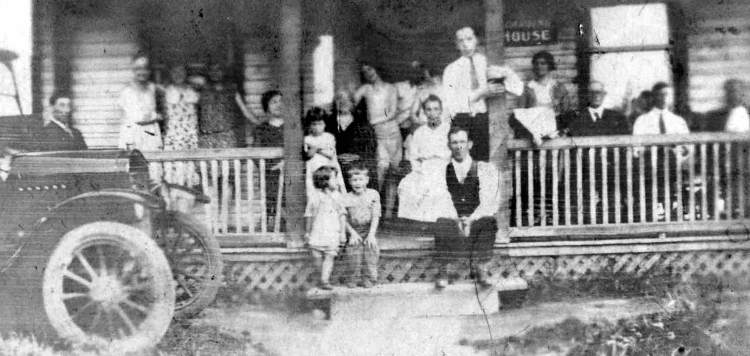
This image offers a peek into life in Huntsville in 1929.
The home of Hugh and Amanda Cooper was located at what was then 27 Minerva Street (today between the corner of Minerva and Centre Streets and what is now Huntsville Public Library at 7 Minerva Street East).
Amanda (nee Leflar, 1887-1932) and Hugh Cooper (1883-1948) were married in Burks Falls on April 25, 1906, and lived here between 1923-1932. They had 13 children, thought three died at birth. Hugh (sitting on the step) worked for Muskoka Wood. His mother, Frances Jane Connor Cooper, is seated behind him. Note the “Boarding House” sign to the right of the doorway.
We don’t have further details about the family – if you know more, drop a comment below.
The vehicle on the left is a Model T Ford. Driving around Huntsville then was not quite the same as today. Many vehicle owners chose to put their cars on blocks for the winter. By the end of the 1920s, the provincial government tried to keep the stretch of highway north of Severn Bridge open in the winter, and in 1929 town council worked out a cost-sharing program with the province to complete paving of the highway through Huntsville. In 1930, the province paved the stretches between Muskoka’s major towns.
Provincial drivers’ licences were introduced in 1927 due to rising accident rates—road improvements meant people could drive faster. All drivers had to take a $1 road test.
In 1921, traffic semaphores, a precursor of traffic lights, were placed along Main Street at Centre, West and Brunel. In 1929, the province made Huntsville’s Main Street a “through street”, and all traffic entering the street had to stop at the intersections. Stop signs were erected and strictly enforced.

Photo courtesy of Muskoka Digital Archives. Details courtesy of Muskoka Digital Archives and Huntsville: With Spirit and Resolve.
See more Wayback Wednesday photos here.
Don’t miss out on Doppler!
Sign up here to receive our email digest with links to our most recent stories.
Local news in your inbox so you don’t miss anything!
Click here to support local news
I have no information on the Coopers, but if any of the family remained in Huntsville, I’m sure a history could be searched out. I took note though, of the ‘Boarding House’ sign since it was a similar place where I was born. Mrs. Poirier’s, at #6 Cora street.
As for winter transportation by car, with permanent anti-freeze being either rare or non existent, car radiators and water jackets had to be drained in winter, because water left in the engine would freeze and destroy it. There were no such thing at snow tires, maybe tire chains, and few plowed roads.
The railroad and the telegraph were the only reliable ways of getting people and information in and out of the area. Even they could be knocked out.
A March storm in 1931 delayed the train and took out the telegraph. Mr. Sid Davis , accountant for the Bethune Pulp and Lumber Company, later apologized to his uncle, Mr. R.B. Whiteside of Duluth , Minnesota for the company reports being sent late.
A Jan. storm in 1935 cut the area off and plows were dispatched from the south; the Forester reported that Huntsville still had no snow removal vehicles. One of those plows, likely big Lynn tractors, broke down near Belle Ewart (Barrie) while the other pressed on, arriving safely in Owen Sound!
How many people had driven from Toronto to Huntsville in 1935?
I wonder what the Cooper family porch photo would have looked like after one of those storms. Maybe fewer people and no smiles.