
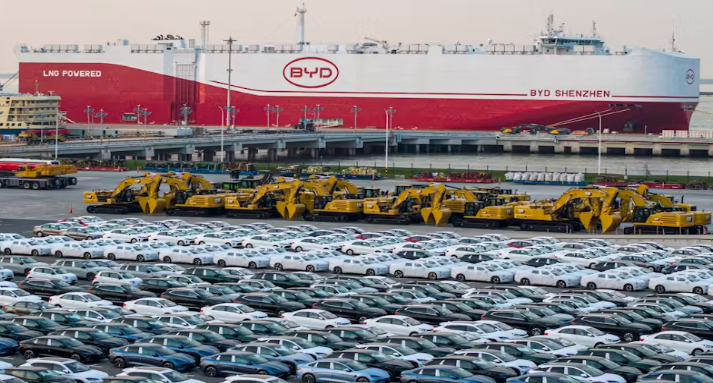
China is serious about tackling climate change. That’s a good thing because one-third of global emissions come from China. The global energy supply, climate change, and the global economy are inextricably intertwined. No country alone can solve climate change. Emissions from China (at 9 tonnes per capita) affect the US and Canada (at 14 tonnes each per capita) and vice versa.
The overwhelming majority of climate scientists, including those in China, agree that the Earth’s climate is warming, and human activities (especially rising greenhouse gas emissions) are the primary cause. The consequences include very high costs from rising sea levels and extreme weather events, unaffordable insurance, unrest, and mass migration from the most vulnerable and fragile countries.
This consensus is backed by decades of research from every major scientific organization, including NASA, NOAA, the IPCC, and national science academies from over 30 countries. There is a small minority with political or industrial interests that still question the consensus, but their views don’t hold up under scrutiny.
Global energy experts say we are running out of oil and gas. The International Energy Agency (IEA) is a Paris-based autonomous intergovernmental organization established under the OECD (Organisation for Economic Co-operation and Development) after the 1973 global oil crisis, to provide analysis, data, and policy recommendations for the global energy sector. They say that in a world of 8 billion people, peaking at around 10 billion by 2050, the global energy mix must change dramatically.
| 1987 | 2021 | Phase 1 -2025 to 2050 | Phase 2 – 2040 to 2060 | |
| Population | 5 b | 8 b | 10 b | 10 b |
| Energy use | 344 Q BTUs | 550 Q BTUs | 440 Q BTUs | 440 Q BTUs |
| Fossil fuels | 87% | 80% | 15% | 0% |
Q BTUs = Quadrillion BTUs
Currently, 80% of the world’s total energy supply comes from fossil fuels. But if you divide proven global reserves of oil and gas by current annual consumption, they are good for about 50 years. If consumption follows population growth, they will be good for 8/10 x 50 or 40 years. Uranium is good for 140 years. To avoid energy shortages, we must accelerate the global transition from fossil fuels to zero-emission energy. Finding more oil and gas just exacerbates the climate problem.
If we accelerate the application of now-available and much more efficient uses of energy, such as electric and hydrogen-powered vehicles and mobile equipment, and electric heat pumps for heating buildings, energy consumption for those uses will be decreased by about two-thirds. That means we might be able to stretch oil and gas beyond 2050 for the most difficult to change applications, such as aviation and maritime shipping.
According to a recent UN survey, 85% of 200 countries support a swift transition to clean energy. Denmark, Costa Rica, and Uruguay are examples of remarkable success. But not all have the resources to do it. The policies of the Trump administration are widely considered to have resulted in a significant setback to the US clean energy transition and will affect countries like Canada, which have strong ties to the US.
Data below from the IEA (International Energy Agency) shows the global energy mix in 2021, the countries using the biggest % of each energy type in 2021, and potential use and potential supply in 2050. Every country can have its own unique version of that global mix. Canada is very fortunate to have them all. Diversity of energy sources provides resilience against supply disruption and opens opportunities for all kinds of innovation, and many jobs with a good future.
| 2021 | Biggest % 2021 | 2050 | ||
| Energy Use | 550 Q | 440 Q | ||
| Solar | 0.7% | Spain 4.5% | 20% | Ideal for daytime peak loads |
| Wind | 1.9% | Denmark 8.5% | 20% | Night generation compliments solar |
| Hydro | 2.7% | Canada 11% | 10% | Stable Baseload, min disruption with run-of-river |
| Bio / Waste | 9.0% | Brazil 25% | 10% | Waste-to-energy |
| Geothermal | 0.1% | N Zealand 10% | 10% | Stable baseload + cogeneration of industry heat |
| Big Nuclear | 5.3% | France 41% | 5% | Stable baseload with very high output |
| Small Reactor | China, USA 1% | 10% | Stable baseload + cogeneration of industry heat | |
| Natural Gas | 23.9% | Canada 39% | **5% | Needs CCUS to mitigate emissions |
| Oil | 29.4% | Spain 42% | 5% | Hard to replace for aviation & marine shipping |
| Coal | 27.0% | China 61% | **5% | CCUS essential for viability |
| Total Supply | 100% | 100% |
The last 35 years replaced only 7% of finite fossil fuels in the global energy mix. The next 35 years must replace 65%. The IEA’s Net Zero Roadmap calls for phasing out new internal combustion car sales by 2035 globally. The IPCC calls for developed countries to phase out oil and gas by 2040 and developing countries by 2050. Both say the global transition is best done in two overlapping phases.
The primary phase (2025 to 2050) will eliminate fossil fuel uses in sectors where good alternatives already exist (cars, building heat, electricity, short-haul transport) in order to save some oil and gas for the most difficult to replace applications after 2040, such as aviation, and marine shipping.
The secondary phase (2040 to 2060) will continue to use up the last remaining oil and gas, until viable substitutes (Hydrogen, ammonia, and sustainable aviation fuels such as canola oil) can be fully developed and scaled up for the most difficult to replace applications.
That’s a tall order, but what’s the alternative? If we cling to finite reserves of fossil fuels until they are used up, we will sleepwalk into a crippling triple catastrophe with an unlivable climate, global energy and food shortages, and more widespread migration and conflict.
A smart two-phase transition to efficient uses of energy and Zero-emission energy sources would give the world a quadruple win. We can avoid global energy shortages, reduce the crippling costs of climate change, and every country can become more self-sufficient in energy production, and we can have a robust global economy with millions of jobs and a good future.
Canada has the second-longest oil reserve life (reserves /production) of the six countries that could still be producing oil in 2050. Canada can help ensure the world gets to Phase 2. But we need two new pipelines (one oil and one gas) before the smaller reserves are depleted. The Trans Mountain oil pipe and the Coastal Gas Link enable exports to the west. New 1,500 km lines to Hudson Bay would enable exports to the east at much less cost than 4,500 km lines to the east coast.
But at the same time, we must reduce our two biggest sources of emissions. Oil sands production and transportation each contribute 25% of Canada’s emissions. We can eliminate emissions from oil sands production with CCS (carbon capture and storage) or, much better still, by replacing natural gas heat for melting bitumen with clean heat from Alberta’s abundant geothermal wells, or small modular reactors, both of which can cogenerate clean electricity for the Alberta grid.
Fretting about unaffordable EV prices and/or charging convenience is “normal” resistance to change that we can no longer afford. When the net cost of an electric car or light-duty truck, including initial price, energy, maintenance, and depreciation over the 5 to 7 years of average ownership, is considered, electric vehicles are already the low-cost option. EV charging is already faster and more convenient than filling up gas vehicles for most owners and is rapidly improving. By resisting/delaying change, we are trading our children’s future for small conveniences today.
All major vehicle manufacturing countries have/had EV sales mandates and incentives because mandates provide planning stability for manufacturers, supply chains, and energy infrastructure (electricity and oil), without which confusion destroys the benefits of massive EV investments.
Due to the disruption of Trump’s irrational energy and climate policies, Canada recently paused its EV mandate. But Trump’s madness will soon end, and the need for EV mandates will be stronger than ever.
Solving this global conundrum is all a question of who pays and when. When to pay? Efficient and clean are the key words. It’s ultimately much faster and cheaper to adopt the now available efficient uses of energy and clean sources of energy, ASAP. China is clearly on that path.
Who should pay? Could it be the 175 countries below China that make 1 tonne to 10 tonnes of emissions per year, and $1000 to $10,000 per capita per year? Or should it be the 25 countries above China that make 10 tonnes to 40 tonnes of emissions per year and $10,000 to $100,000 per year? Should the government pay? The government is us. No matter how you cut it, taxpayers will ultimately pay. So, it behooves us all to get on board and support a rapid transition to efficient uses of clean energy.
In summary: If oil becomes unreliable and climate threats intensify as is widely expected, EV and other energy transition mandates aren’t just government fiscal policy—they’re survival strategies.
Hugh Holland

Hugh Holland is a retired engineering and manufacturing executive now living in Huntsville, Ontario.
Don’t miss out on Doppler!
Sign up here to receive our email digest with links to our most recent stories.
Local news in your inbox so you don’t miss anything!
Click here to support local news
Thank you, Mr. Holland for your helpful article, well expressed to help me to understand the problem and best solutions.
Mr Holland, thank you very much for your excellent scientifically and statistically poignant and comprehensive article. The amount of inconvenient truths makes your findings difficult to argue with, hence the absence of usual comments, even from the sides of the climate change deniers.