
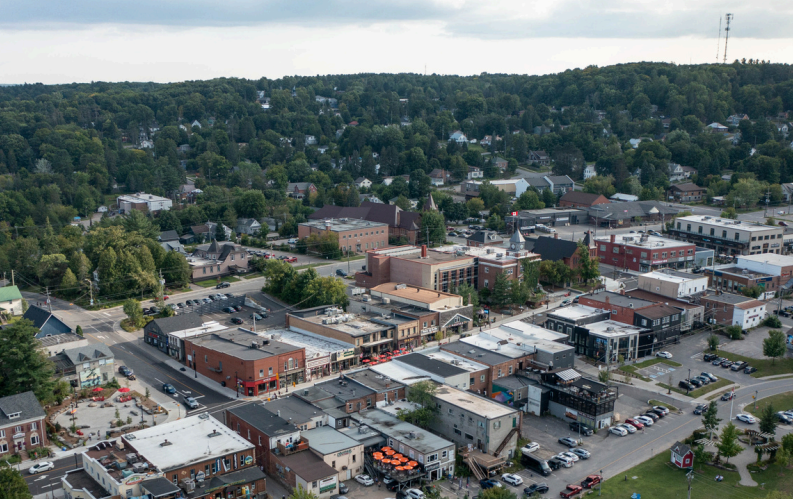
At the June 10 Huntsville Planning Council, the majority of councillors voted in favour of new height and density rules for Huntsville.
The recommendations, which focus on increased building height and density within the town’s Urban Settlement Area, will be incorporated into the Town’s Official Plan and Community Planning Permit By-law.
Town planning staff provided further amendments approved by council, which they said are designed to provide clearer criteria for developments seeking additional height and density while ensuring growth remains compatible with surrounding neighbourhoods and natural heritage features.
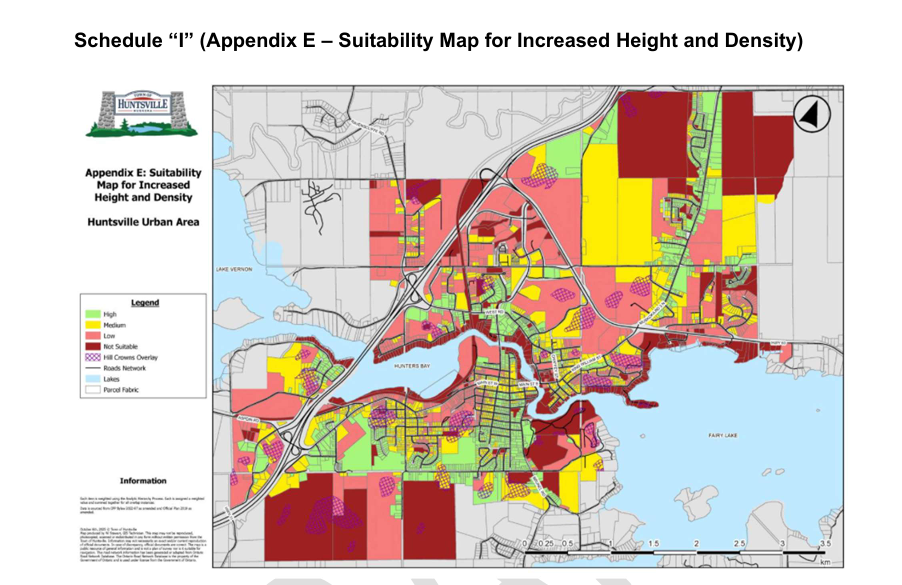
The height and density policy allows building heights of up to four or five storeys or up to 15 metres in designated areas identified as having a high suitability for increased density, provided developers meet a series of performance standards and deliver community benefits.
Community benefits could include affordable housing, public art, transit infrastructure, park improvements, active transportation amenities, or cash contributions.
Under the amendments, developments seeking greater height would be subject to requirements such as landscape buffers, building step-backs, visual impact studies, bicycle parking, amenity spaces, and enhanced design standards. Projects exceeding 13.2 metres would also be required to provide a Planning Justification report or a Landscape Visual Impact Study.
A major component of the policy is the protection of hill crowns, ridgelines, tree lines, and significant public views. New policies prohibit height increases beyond established limits within designated hill crown areas and require developments adjacent to these sensitive landscapes to demonstrate that important views and natural features will not be negatively affected.
The proposed amendments follow a public meeting held on May 13 and an open house on April 29, where residents provided feedback on the draft policies. According to staff, many submissions supported the proposed direction, while others raised concerns about how new height definitions, hill crown protections, and performance standards could affect previously approved developments and future projects.
In response, staff made several revisions to the Community Planning Permit amendment, including greater flexibility for certain landscape buffer requirements and clarification that developments previously approved would not be subject to the new standards.
Staff maintained that the amendments are consistent with the Provincial Planning Statement and conform to the Town of Huntsville Official Plan.
The majority of council, with the exception of councillors Cory Clarke and Scott Morrison, voted in favour of OPA #10, which will be forwarded to the District Municipality of Muskoka for approval before taking effect.
What councillors said
Huntsville Mayor Nancy Alcock voted in favour of the policy. She said it protects character and the community’s natural heritage features while also promoting increased height and density in areas identified.
“If we were looking for a policy that pursues aggressive housing implementation in our town, this probably doesn’t do it. There are other municipalities that are on a faster track, like Orillia, Barrie, or whatever. But if we’re also looking at a policy that doesn’t promote any height and density, well, this doesn’t do that either. It’s somewhere in the middle. It’s a moderate move, and I think for that reason, it works really well,” she said, adding that the policy ensures that higher development results in good development. She said it is incremental. “It says we do want to address projects that need to be four storeys or even five, but in these areas, and we will work with you to ensure that it’s a really great development.”
Councillor Scott Morrison voted against the implementation of the policy. He said, given the push from the Province for more housing, he’s concerned that there will be more Ontario Land Tribunal (OLT) hearings, which he said would be costlier for the municipality and ultimately taxpayers.
“As it stands right now, I love it. We did it for a reason. I don’t know if I can push forward today… We ordered this to protect the character of Huntsville, because we knew big buildings were coming. We knew there were areas where it was justified and areas where it was not. We wanted to have a roadmap for developers to know where we would encourage this to happen. [It] makes it every bit better for everybody, but since we went down this road, Bill 97, Bill 98 have come out, Bill 100 have come out. There’s a lot of changes happening… Bill 98, that came out, is considered one of the most significant planning alterations in the Province’s history, and right now, unfortunately, parts of our bylaw would contravene that legislation,” he said. “And what I’m worried about is the potential impact on the taxpayer if it creates more conflicts and OLT hearings, if our bylaw doesn’t conform. Now we do know we’re a bit insulated because we’re under a CPP, but there is nowhere in there specifically exempting municipalities under a CPP,” he added. “It could cost the taxpayer money on defending OLT hearings, and it might impact our ability to accomplish our goal. So I think at the moment I just, I think I need more information. I think I need something more definitive from the Province to us to know whether we are exempt before we put something in that would contravene Bill 98.”
Councillor Cory Clarke also voted against the height and density changes, but for entirely different reasons.
He thanked planning staff for all the work they have put into the policy, but said, “I’ve been pretty consistently against the policy as it’s worked its way through the planning department. And that’s because I believe that this policy could be used to fundamentally alter Huntsville in the future. By design, the policy allows for much taller buildings in Huntsville while encouraging developers to build them, albeit with precaution measures. It may accelerate us further away from the town that many of us grew up in and love, and that’s my concern. While others may view the policy as a protective measure, I see it a bit differently. To me, the policy poses a threat to Huntsville’s identity, rather than safeguarding it, and once that identity is lost, we may never get it back,” said Clarke. “We haven’t yet seen how higher buildings that this council has already approved will actually look when they’re built, as opposed to the plans on paper,” said Clarke, adding that it may be a shock, and for those reasons, he said he would not be voting in favour of the policy.
“I think this does protect our community. I think it sets the standard for the builders to build where we think they fit and not where they don’t fit, and I think that’s what brings us to the OLT, when they want to build buildings on slopes, etc.,” said Deputy Mayor Dan Armour. “And Councillor Morrison about Bill 97, 98, etc. If we wait for the Province to make those decisions, we’ll be here next year discussing this, so I think we need to move ahead, and we can adjust [on]the fly if we have to, as we’re going to the OLT. They bring it here to us, we discuss it, and if it fits, we could approve it even though we have a policy in height and density. So we have the tool still in our toolbox to be able to make it work. So, I’ll be approving this today,” said Armour.
Councillor Jason FitzGerald voted in favour of the policy. He said a lot of consultation has taken place. “I think it’s a good move… the developers now know locations we have approved and they can have a reasonable expectation of a speedy process and stages and breaking ground and building. As far as preserving the heritage of Huntsville and what we are and what we want to be moving forward, we can’t stop growth, and I think we’ve done a very good job of trying to manage how it does grow and where it grows. So I will be supporting this. And as far as the OLT comments… I can’t see an increase from my point of view.”
Councillor Helena Renwick thanked the municipal planning and GIS staff for the efforts that went into the policy. “I think we are one of many municipalities around the province of Ontario that are dealing with height and density. And we are struggling with how to be progressive and how to prosper and grow in our community, but we also want to still maintain why people come to our community and that’s what Councillor Clark was talking about. You know we love the rocks, the trees, the water, but how do you find that balance? And I think what staff has given us today is a tool, and I think it’s well-conceived. I think it’s thoughtful. I’m not going to feel pressured by Bill 97 at this time, or 98, sorry, even Bill 100. It will come down the road as well. We’ll have to deal with it, but I think at this point, this gives us a tool to move forward. I love the character of our town and I sit on the historical board, like I also see the history that’s here but I also see that things are changing and it doesn’t mean that we are changing for the worse, we are changing for the better so I am in favour of this,” said Renwick, adding that it’s a tool in the municipality’s toolbox. “We can still deny applications if we want to, if we need to, but this gives us an ability to stop it or to slow it down. I’d rather have the tool in our toolbox than not.”
Councillor Stone, who also chairs the planning committee, voted in favour of the policy.
“For me, we’re growing like it or not, and that’s been said around the table, so we need to ask ourselves, do we want to say where it’s appropriate to grow and where it’s not? I think this sets forward for the future a plan that we can live with, and more importantly, I have heard from developers about this plan that said, ‘thank you for clarifying where it’s okay for us to build high and where it’s not.’ And we went to the public and said what do you love about this place? What are the vistas that you want to keep? And our staff and the GIS people mapped it out and made it perfectly clear that these places will never be touched. You cannot build on the top of these hills ever. Or you can’t go high at the waterfront. It protects what we love about this place,” said Stone.
Councillors Monty Clouthier and Dione Schumacher were absent from the meeting.
Don’t miss out on Doppler!
Sign up here to receive our email digest with links to our most recent stories.
Local news in your inbox so you don’t miss anything!
Click here to support local news
Susan, This is the point that I made at the meeting. This study was not about encouraging big tall buildings throughout Huntsville, it was in fact the opposite. We recognized that more and more developers were asking for height exemptions and we we’re worried about how that’s going to impact the character of the town.
We asked for this study to determine where, if anywhere, an extra story could be built in the town without having a visual impact. The staff did an incredible job of identifying some areas in town where it might be appropriate, and their study was based on a ton of feedback from the public, including a public meeting. Having a study like this helps us say no to applications when we feel that they could have a negative visual impact. There is a benefit to having an extra story in appropriate areas. It makes the building more affordable, especially when it is for rentals. It also increases the tax assessment collected on that one building. To get the same assessment growth, it might involve a bunch of different lots and a lot of environmental impact.
The reason I brought Bill 98 up at the table is because that bill takes away some of the rights that we have as a municipality. Two of the key things we wanted in the height and density study was the ability to request landscape buffers and visual impact studies. Bill 98 is taking both of those items off of the table.
We are under a community planning permit by law along with only three or four other municipalities in the province. And the province doesn’t seem to address that in the bill. So I just wanted more clarity to make sure that we were allowed to ask for these items. They were raised as very important issues by members of the public. So I want to make sure that we have the authority continue to ask for them. Hopefully the province will allow this, otherwise it goes against what the public has said that they want.
But, if we implement it in a contributes provincial legislation, it could lead to a lot more hearings at the OLT, and they rarely side with the municipality. And if we choose to defend our position, it costs taxpayer’s dollars to do so. It’s a bit of a mess to be honest.
Taking some time after reading this Council action/vote, and, after slogging through just one of the Bill’s (Bill 98), I’ve come to the conclusion that the Ontario Premiere and his government are intent on gutting the powers of our Municipal safeguards and elected officials. Joanne said it correctly: “ride rough” over the rights of the people who have to live with these future developments. Cory Clark seems to be the only Councillor who truly understands the magnitude of these two-faced policies (for lack of a better term). Ford is decimating democracy in sneaky, underhanded ways and we all seem to be like the frog sitting in quietly increasingly boiling water as there, ultimately, is no recourse from greedy developers. Threats seem to be all around (higher taxes, tribunal challenges etc). It would be interesting to see which would “trump” the other; strong mayor powers or developer challenges to the Municipality. Time will tell as we have (so far) the power to vote for a new Mayor and Council this fall. I want to see more people with some backbone just like Cory Clark get on Council. Just because we aren’t all lawyers or elected officials doesn’t mean we have no say. See you at the Polls! P.S. Think about Sabrina Park, Forbes Hill, Crescent Bay and all those views ..how does that feel? Do we want more of that?
I attended the open house and was impressed by the thoughtful effort put into the planning for height and density and the presentation. I was particularly pleased by consideration of the significant views of the Huntsville landscape submitted by citizens. The current government’s priorities for development may ride rough over local considerations and local council decisions about planning, ignoring also environmental values. ( Strong Mayors and appointed regional chairs with similar powers) Mr Morrison’s concerns about costly challenges at the OLT are very valid, but hopefully developers will work with locals about concerns to preserve the economic values of Huntsville character. That Good Will and respect add long term value to their projects.The Town can’t just lie down and get steamrolled by provincial policies that do not.
Any councillor/mayor that supprted this bill should not now or ever be re-elected. Many voted for the out of code apartment building under construction on mail street. These elected individuals care about devevelopers not Huntsville resident and culture. It addition a bill so dramic should wait for new council.
Thank you councillor’s Morrison and Clarke for trying to protect the heritage and fabric of our community.
It’s a bit of a joke to have 4 or 5 as the upper allowance.. Might as well have just said 5 storeys.
How long will it be before that limit will be exceeded.
This policy by the inept council ixs the destruction of Huntsville and Muskoka culture and environment. This town is becoming more like Barrie every day and will ber recognized as ther “ARMPIT OF THE NORTH”. Some comments on the councils comments are:
Huntsville Mayor Nancy Alcock voted in favour of the policy. She said it protects character and the community’s natural heritage features while also promoting increased height and density in areas identified.
COMMENTSD: NOT SURPRISED THAT OUR MAYOR MAKES THIS COMMENT BUT IN REALITY THIS WILL DESTROY HISTORICAL FEATURES. BUT NOT SURPRISED SHE TOOK THIS AS SHE HAS THIS IS JUST A CONTINUATION OF DISREGARD FOR ANY OFFICIAL PLAN AND MUSKOKA CULTURE.
Deputy Mayor Dan Armour said “I think this does protect our community. I think it sets the standard for the builders to build where we think they fit and not where they don’t fit, and I think that’s what brings us to the OLT, when they want to build buildings on slopes, etc.,” said Deputy Mayor Dan Armour.
COMMENTS: THIS IS ABSOLUTELY ABSURD AND SHOWING A TRUE LEVEL OF INCOMPETENCE. HE GIVES AN IMPRESSION THAT HE GIVES IN TO DEVELOPERS AND HAS NO SUPPORT FOT OUR HERTIAGE AND ERNVIRONMENT.
Councillor Jason FitzGerald voted in favour of the policy. He said a lot of consultation has taken place. “I think it’s a good move… the developers now know locations we have approved and they can have a reasonable expectation of a speedy process and stages and breaking ground and building.
COMMENTS: THIS COUNCILLOR IS SELLING HUNTSVILLE TO DEVELOPERS AND CREATING A BARRIE PLA,
We MUST get rid of most of ths developer friendly councillors and ensure we deevelop a nd get councillors who support residents.