
At the February 25 General Committee meeting, Huntsville Operations Manager Brandon Hall gave councillors an update on winter operations in the municipality.
Hall said the Town maintains 380 km of municipal roads, 23 parking lots, and seven laneways. Winter operations has 24 employees and provides 24-hour coverage and has three shifts. The shifts run from 4 a.m. to 12 p.m., 12 p.m. to 8 p.m., and 8 p.m. to 4 a.m.
He said winter operations have 10 winter runs. Nine are sand runs, and one is a priority salt run, and each route takes approximately 10 to 12 hours to complete.
“Our priority salt run focuses on higher volume and critical routes. Salt allows us to prevent ice bonding and return these roads to bare pavement faster, which supports emergency response, traffic flow, and compliance with MMS (Ontario Minimal Maintenance Standards) timeline,” stated Hall.
So far, the Town has used 532 tonnes of salt. Hall said when temperatures are too cold for salt, a sand/salt mix (referred to as a sweet load), or a pre-treatment, will be applied to priority areas.
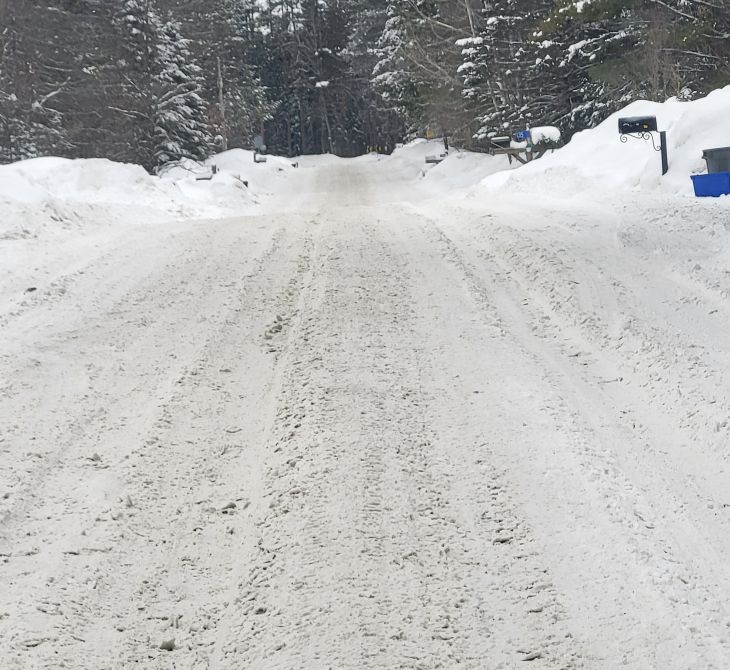
As for sand, it’s more suitable for lower-traffic-volume roads. He said it provides immediate grip for vehicles. It’s effective in all temperatures. It’s essential in cold weather and improves safety on hills, intersections, and curves. “Most of our sand routes we do sand, but there are times when they go out, and they don’t sand the entire route. Straight stretches will remain unsanded, but we might do hills and corners,” he explained. “Weather does play a big factor in the materials that we use and how it works.”
Hall said sand is reliable in very cold conditions and cost-effective for local rural roads. “Sand does not melt ice; it provides traction,” he reiterated.
He said this winter has brought significant weather activity. One significant weather event was declared, which meant Ontario Minimum Maintenance Standards and timelines were not adhered to.
Hall also said temperature fluctuations have an impact. “Over the last month, we’ve experienced significant fluctuations in temperature. It has required more sanding and salting cycles. As you can tell, we are having ourselves quite a winter.” Hall said such fluctuations increase the amount of materials used, increase equipment wearand result in higher collision risks and public exposure.
Hall noted that when it gets really cold for an extended period, the salt or sand that was previously laid doesn’t work. “So it’s not reacting to the weather, so again you get your snow build up… you know, all we can really do is go out and try to shave it down. We’ll put graders out there to try to get it down, but we also don’t want to cut too far down [so] that we’re wrecking our asphalt. Then it becomes another issue to fix in the summertime. “
He said the minute warm weather is anticipated, they’ll start pretreating high-priority roads. “So the minute the sun hits it, things break up. And you’ll notice we did receive quite a few calls about people thinking roads weren’t plowed, but that was coming out of that cold snap into the warm spell, where the roads did break up, so the material that we were using absolutely did its job. That’s when we go in and slush those roads off, and we’re back to bare pavement.”
Hall was asked why some roads are maintained down to the bare pavement while others are not, particularly in rural areas. He said the high-volume roads, steep roads, arterial roads, and roads frequently used by emergency response are considered high-priority roads and maintained down to bare pavement. While roads in rural settings, he said, tend to be high-float, low-traffic-volume roads and, based on the MMS, are not required to be maintained to bare pavement. “And with a surface of high float, it’s important to keep it snow-packed,” so that it can be more easily plowed and protected, said Hall.
Asked what lessons this winter has provided during his first year at the helm, Hall said that taking time to do preventive maintenance on equipment needs to be built into the schedule.
He said staffing is also a challenge. “We are in a unionized environment, but outside of that, there’s a lot more that’s required.” He suggested that perhaps some contracted services could help with the service the municipality is trying to provide. “Other than that, it’s just trying to stay on par and trying to keep up with it.”
Hall said he thinks the three-shift program works well. “Do we need more staff? Absolutely… there is no down time for them. There is no holidays for them during the winter months. They get worn out; that’s when the fleet starts to break down, things get a bit careless, and safety goes out the window. So we’re really trying to stay on top of that, but it’s a revolving door, I can say that.”
He said staffing is important, particularly as Huntsville grows. “Right now… we’ve got staff off. We’ve got part-timers that are no longer here or having a hard time holding those jobs down in order to meet our full winter complement, so it’s been a struggle that way.”
Hall said once winter winds down, a report will return to council on ways to improve winter operations and efficiencies. Parking lots will also be included in the report.
You can find Hall’s PowerPoint presentation HERE (pdf). Note that the number of winter maintenance operation employees was later updated to 24, not 26 as initially stated in the report.
Don’t miss out on Doppler!
Sign up here to receive our email digest with links to our most recent stories.
Local news in your inbox so you don’t miss anything!
Click here to support local news
What isn’t mentioned in this article is the fact that people just have to drive regardless of the weather! If you don’t have to drive to work or get to a critical appointment, stay home. Give the crews a chance to clear the snow. If you live on a “back” road consider getting a vehicle that is suited to winter driving. Safety out the window? Maybe that statement should be examined. Also , if salt is applied at the wrong time it can make things worse because it turns snow to water that can freeze and turn to ice.
Thanks Brandon, the roads in my neighbourhood with a hard winter, have never been better. Not easy in thi d to please everyone..
Extra sand at George and Wilmott corner made a huge difference in the hill.
I’ve read the bit from councilors as to everything being against them. The Province, OLT, contractors who say here on Doppler ‘this is what you get, like it or not.’ “If I don’t get my own way, I’ll throw a bag of lawyers at you.” And I get it, times are tough. Stressful. But be a little less plaintive maybe.
As segue, I worked as a member of ‘Health and Safety’ for 15 years or better. Took a lot of flack from the very people I worked with. But for a management person to put in print “things get a bit careless and safety goes out the window!” ??? Maybe a spur of the moment statement, but needing a definite rethink, reword and attitude adjustment.
Route plowing is sometimes non-existent for days out our way. Keep at it council. Rooting for you. Not a job I’d ever want. Not a job that would want me I’m sure. But it’s hard no not see some of these constructs as future ‘projects’.
Hope I’m wrong.
What a balancing act! Believe me your teams efforts are greatly appreciated. Staff safety, training and equipment availability should be a high priority if we want Huntsville to grow and prosper. We may pay more but after all we live in a snow belt.I don’t want to read that council is cheaping out.
I really like the level of detail and nitty gritty (pun intended) covered in this report.
This topic is of course vital to our community, we have a warming climate with high amounts oflakeeffect snow. I’d like to understand how municipal efforts are coordinated with District and Province o terms of operations and funding.
Well done!
The mechanics for public works don’t do preventive maintenance (pm), that’s the problem. They even hired a third mechanic to help catch up with repairs so that preventive maintenance could be done, but because pm hasn’t been done, machinery is constantly breaking down. Its a vicious circle with no accountability for work being done by the supervisor of the shop.
Now the third hired mechanic is leaving so expect things to get much worse.