
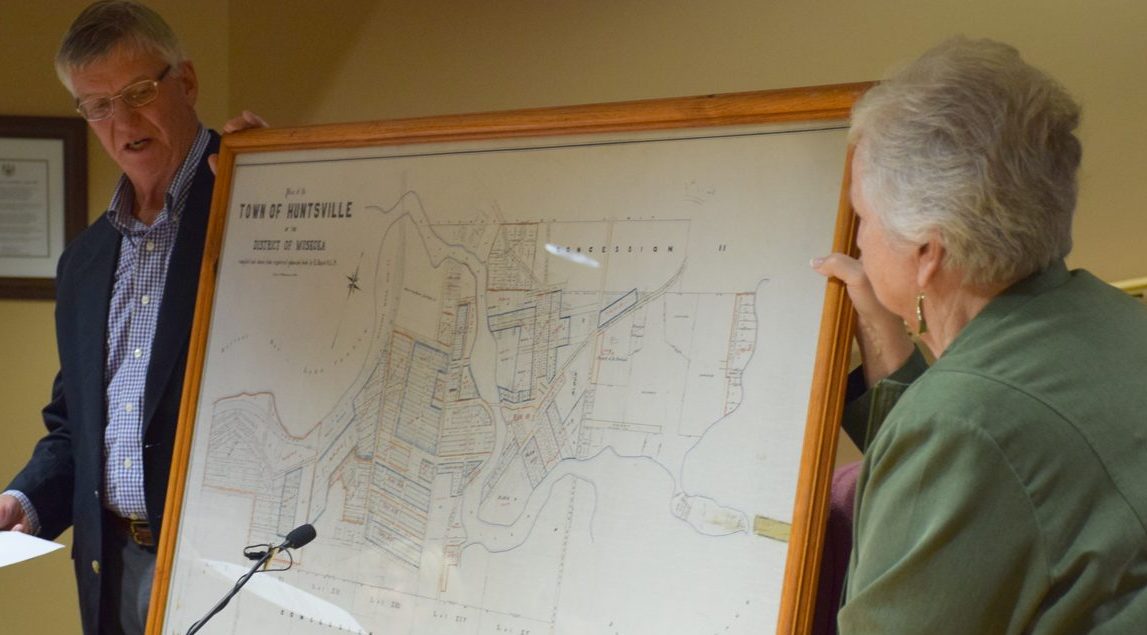
Former Huntsville lawyer and Lake of Bays Mayor Tom Pinckard was before Huntsville council on Monday accompanied by his former legal assistant of 40 years, Pat Rimmington. Together they presented the Town with a hand-drawn survey of the Town of Huntsville as it existed in 1901.
The survey was prepared by Edward Bazett in 1906. He was a surveyor from Burk’s Falls who eventually moved to Huntsville. When Pinckard took over the practice of former lawyer Bert Schuch in 1981, he acquired all the legal documents and maps and surveys associated with the practice.“He came to me one day and said here’s something you can have but it doesn’t belong to you, and it was this plan,” Pinckard told council at its October 24 meeting.
He explained that in 1868 the province was trying to push development north of Bracebridge. “The Muskoka Road had reached Bracebridge but it had stalled out around Stephenson and they passed the Free Grants and Homestead Act to encourage settlement.“
Pinckard said that because of that road, Gravenhurst was incorporated as a Town in 1860, Bracebridge in 1861 and the Muskoka Road pushed through to the south of Huntsville in 1863. He said eventually the road made its way to where Huntsville’s swing bridge sits now, in 1870. “In 1870, when the road arrived, Huntsville then had enough status that it was actually given a post office and that’s when it had a legal name. That was the first time Huntsville was known as Huntsville,” he noted.
In 1886, the railway made its way to Huntsville and “if you recall, 1886 was the centennial of Huntsville. The key to the arrival of the railway was that’s when the Town was incorporated but only as a village and I didn’t know that until doing some research,” he said. It wasn’t until 1901 that the Town was actually incorporated as the Town of Huntsville.
“So as the story goes,” recounted Pinckard, who said he got the story from former lawyer Schuch, “Bazett prepared this in 1906 and he actually worked at it for three or four years and what it depicts is all the plans of subdivision that comprised the Town of Huntsville in 1901.”
Pinckard said that while many of the streets depicted will be recognizable, there are historical parts of the town that at the time were big blank areas such as where the former tannery and lumber operations were as well as where the railway was. He also spoke about an area designated as Market Square, which was similar to the old English town plans. “If you look at it you’ll see it immediately,” said Pinckard. He said it comprised Blackburn’s and the town homes along that shore as well as the area of the plaza, in behind where an auto repair shop was once located. “Of course when Brian [Thompson] and I were kids here that was nothing but swamp, there was nothing there. There were auto bodies in there, transmissions, logs and the like. The only sustainable land in there was where Blackburn’s had reclaimed it enough to have their marina and some low-lying buildings. But when this town was incorporated nobody ever conceived that there would ever be anything in there. How right they should’ve been.”
Pinckard said the survey includes some handwritten notes by Donald Mackenzie Grant, Huntsville’s second lawyer, who got the survey from Huntsville’s first lawyer, George Summerville Wilgress, when he died. His practice was where Café Wilgress sits today.
As for Grant, Pinckard said he’s surprised he hasn’t been recognized more. “He was the colonel who actually raised the regiment that went and fought in the war here in Huntsville. I’m surprised we don’t have anything frankly named after him. I mean what he did is, should I say it, legion for this town.” Pinckard said Grant had the survey until 1958 when he stepped down as solicitor and then gave it to Schuch, who then passed it to him.
“In 1958 there were only eight lawyers in the entire Muskoka district at that time and they’ve proliferated since.” Pinckard, who retired in 2012, said he called the mayor to clear his conscience and gift the survey to the Town on behalf of Bazett, Grant, Schuch and himself. He asked that the survey be displayed in a prominent location for others to see.
Don’t miss out on Doppler! Sign up for our free, twice-weekly newsletter here.
Thanks Tom~~A great historical gift! Capt. Hunt is buried in the Madill Cemetery~~hopefully the Pioneer Church there will be preserved!
Nice work Tom. Too bad that a man named Hunt wasn’t mentioned in the article. He is the man responsible for getting this Town going. Muskoka Road through town, the bridge, the locks, church, school, are just a few things he headed up. Maybe some day we might even see a statue for our great hard working founder.
Tom…..A thoughtful and generous gift to the Town . Well done.
This is very nice of Tom. I encourage having professional copies made to enable the public to purchase them.