
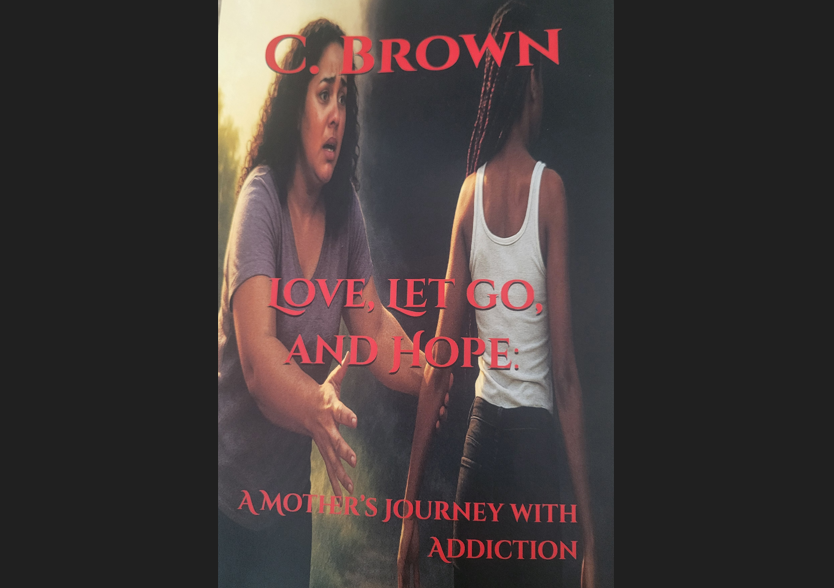
The heartbreaking journey of seeing the light in your daughter’s eyes slowly dim due to drugs is what a Huntsville mom has put into words.
Love, Let Go, and Hope: A Mother’s Journey With Addiction by C. Brown, available on Books.org and platforms such as Amazon, is the culmination of heartbreak, hope, and the need to keep it together.
“I started journaling as a way of healing myself. I was exhausted and tired of being anxious and worried. I wanted to share my journey so others know they are not alone and they too deserve to be heard, and to hopefully spark a conversation that can help families heal, not hide anymore. Change can only happen when we talk about it.”
Brown says many families have great difficulty dealing with the fact that addiction has entered their lives. They often try to hide it, and it becomes a dark, shameful secret. She’s hoping her book will help others going through a similar experience because every parent facing that unforgiving monster needs support.
It was three years ago when she found out her daughter, then 18, was using cocaine. She went from being a straight-A student to barely passing. She started hanging around with a crowd Brown wishes she had never met, and things spiralled from there.
“The community really needs to start paying attention to their kids because they groom them from Grade Eight, when they’re going into high school, the kids have good jobs, and it’s like they’re seeking them out because they’re their next paycheck. They don’t see your child. They don’t care.” She says drug pushers often prey on young people through social media. Befriend them. Get them hooked on whatever it is they’re pushing. “I mean, why are 30-something-year-olds messaging teenagers? Why is that happening?”
Her daughter is now 21 and graduated from Huntsville High School in 2023, and while the drug addiction is finally out in the open, she suspects it could’ve been happening longer than she thought, slowly getting its grip on her. “It’s like a rollercoaster ride watching your child, who you raised, gave birth to, and then watching their soul just drain. They turn into a completely different person,” says Brown.
“People talk about losing loved ones—but no one prepares you for the grief of losing someone who is still standing in front of you. You see them breathe, speak, move—but they’re not really there. It’s a slow, quiet heartbreak that repeats itself day after day,” reads an excerpt from her book, in which she talks about being unable to sleep at night, thinking about her daughter and hoping that she is Ok. Feeling anxiety with every call from an unrecognized number, and turning to her faith, she prays her daughter will find her way out of the darkness.
“She is still that girl full of light and laughter, even if life has dimmed her flame. And I’ll keep believing that one day, she’ll remember how brightly she was always meant to shine.”
Brown reminds those who would pass judgment that addiction is an indiscriminate disease. “Society loves to judge. It points fingers at families like mine, whispering that addiction is the result of bad parenting, poor choices, or lack of discipline. But those whispers are wrong. Addiction is not a moral failing. It is not a punishment. It is a disease – complex, consuming, and indiscriminate,” she writes.
She calls on the government to do more to stem the drug epidemic gripping young people in every corner of this country. To hold the pharmaceutical companies that produce some of these drugs, which they know are highly addictive, accountable, and provide more treatment centres and beds that families can afford.
She also calls on law enforcement agencies to do more. Get the dealers off the streets. She says those in the know are aware of where the drug houses are in this town.
Doppler reached out to the Huntsville OPP Detachment to find out what they’re approach is to battling drug traffickers in our community.
Ted Warman, Community Engagement Officer with the Huntsville OPP, said Huntsville has similar issues to any major city in Canada, just on a smaller scale. “However, because we have a smaller community, it has a significant impact on community members, as we may personally know the people who are struggling with a substance abuse issue,” he stated via email correspondence.
Warman explained that the OPP has a unit called the Community Street Crime Unit, and their role is to address street-level drug issues as well as property crime. “This unit works with many other partners in the community and within the OPP to identify trends, groups, and types of illegal substances in the community. He said in recent years, they have been instrumental in breaking up organized drug trafficking in Muskoka.
“Policing relies on the input of community members through reports and Crimestoppers tips to learn where people are seeing issues, so we can develop strategic approaches to disrupt illegal distribution of illegal drugs in the community.”
What types of drugs are you seeing?
“Cocaine is not domestically produced in Canada and enters our country illegally through other source countries. The OPP is committed to deterring, detecting and disrupting the criminal activity in Ontario that threatens the safety and security of our communities. This appears to be one of the more common drugs in the community at this time,” he noted. “‘Street’ cannabis (not sold in dispensaries) often contains harmful substances, including pesticides, mould, and bacteria, which can pose serious health risks. These contaminants are not typically screened out, as illicit growers are not held to the same (or any) standards as licensed cannabis producers.
“Moreover, illegal cannabis may be contaminated with other substances to increase weight or enhance its effects, making it even more dangerous. Examples include synthetic cannabinoids, which can cause severe and unpredictable health reactions, and other drugs, such as fentanyl, which can be lethal even in small amounts.
“Fentanyl is an extremely potent synthetic opioid prescribed to manage acute and chronic pain. Fentanyl is up to 100 times more potent than morphine and up to 40-50 times more potent than heroin. Fentanyl/opioid users have a higher risk of experiencing an overdose due to fentanyl potency and/or being mixed with other illicit substances, especially when the fentanyl is illicit and not sourced from a pharmaceutical company.
“Because you can’t see, smell or taste fentanyl, it is impossible for a user to determine the quantity of fentanyl they may be using. When fentanyl is mixed with other substances in efforts to prepare it for sale, the end result can produce portions of the mixture that is more potent than other parts. For example, pressed pills may have a higher concentration of fentanyl in one pill versus another pill. Illicit drugs or illicit opioids are not made the same as pharmaceutical medication. When opioids are produced by a pharmaceutical company, they have a consistent dose found in each pill, patch or liquid. When they are produced illicitly, there is no quality control and products are made with widely varying consistency and strength.”
Warman said when drug users purchase and use street drugs, the supply is not safe and often there is unintentional use of other substances that are mixed or “cut” with the drug without the user’s knowledge. Drugs are often mixed with other substances, which are commonly referred to as “cutting agents.”
“Certain substances are also used as “cutting agents” to enhance or mimic the effects of the drug that they are being cut with. Depending on the substances and/or cutting agents, the mixture can produce a synergistic effect where the effects of the drug(s) are amplified.
“For example, in a case where fentanyl is mixed with depressants/tranquilizers (such as benzodiazepines), the combination increases the risk of accidental poisoning and overdose since they will produce amplified sedation/respiratory depression. Also, the risk of overdose is increased because the amplified sedation caused by the benzodiazepines is not reversed by Naloxone.”
Warman said the source of opioids that have been seized in recent OPP investigations is varied. He said illicit fentanyl can be domestically produced in Canada through the use of precursors in clandestine laboratories and/or is being imported from other source countries.
“The OPP will continue to focus on the illicit production and distribution of fentanyl, aiming to prevent cross-border trafficking, target the supply of precursor chemicals and dismantle criminal networks responsible for producing and trafficking illicit fentanyl.”
Carfentanil is another drug being pushed in our community. Warman said it is an extremely potent synthetic opioid that is 10,000 times stronger than morphine and 100 times stronger than fentanyl. It has no approved medical use for humans and is only legally used as a tranquilizer for very large animals, such as elephants.
“It is one of the most powerful opioids in existence; even a tiny amount can be fatal to humans. A dose as small as a few granules of salt can be lethal and can be a major factor in the opioid crisis. It is often mixed with other street drugs like heroin, cocaine, or methamphetamine without the user’s knowledge to increase potency. It comes in various forms, including powder (which can resemble cocaine or heroin), pills, blotter paper, and spray.
“Inadvertent exposure or overdose include respiratory depression or arrest, drowsiness, disorientation, sedation, pinpoint pupils, and clammy skin. The rapid onset of symptoms leaves little time for life-saving intervention.
“Treating a carfentanil overdose is extremely difficult. While naloxone (Narcan) is an antidote for opioid overdoses, multiple high doses may be required to be effective against carfentanil, and even then, reversal is not guaranteed,” he added.
Warman said prescription medications can be acquired legally by patients through a physician’s authorization, but then are illegally sold to others. It can be diverted unlawfully from pharmacies through fraud and forgery. Obtaining the same prescription from multiple physicians (also known as ‘double doctoring’) is also illegal, regardless of whether this medication is for personal use or intended for illegal sale. In other cases, the prescription medication is acquired through thefts, break-and-enters, and robberies from residences and businesses, such as pharmacies or other approved prescription dispensing outlets.
“Individuals should always obtain their prescription medications through established and legal methods, such as a prescription or authorization from a doctor or nurse practitioner, which is then dispensed from a pharmacy. Only through this means can an individual ensure they have the right medication, and not a counterfeit medication or a medication containing other narcotics.”
When was the last time the detachment conducted a drug bust in this community?
“The Huntsville OPP and the Street Crime Unit regularly deal with illegal substances. There is no pattern to finding drugs as it occurs during all types of investigations, such as traffic stops, impaired driving, suspicious persons calls, Crimestoppers tips, etc. We are diligent in holding people accountable for possession of illegal substances,” stated Warman.
“As for a ‘drug bust,’ there was a joint investigation that resulted in a series of arrests in July 2025. The article was posted on Doppler at that time,” he added. “As for known drug houses, the police hope the public will notify the police if there is activity that they believe is suspicious or related to drug trafficking, so that appropriate investigative steps can be taken to investigate these locations.”
Brown, in the meantime, reminds community members not to look at young people struggling with an addiction as simply an addict but a person suffering from mental health issues. “No one ever found their way back through judgment. Healing happens through connection— through people who care enough to say, ‘You matter, and I still see you,'” she writes. “If you’ve ever felt tempted to mock or film someone at their lowest, pause and remember: that person was once a child full of laughter and dreams. This person could be someone you love one day.”
Don’t miss out on Doppler!
Sign up here to receive our email digest with links to our most recent stories.
Local news in your inbox so you don’t miss anything!
Click here to support local news
Why are there at least five places on Huntsville’s Main Street to buy legal drugs?
I wonder about alcohol and it’s role in illicit drug use. And I believe that the sale of alcohol in convenience stores is not a good idea.
This story reflects exactly why Free To Be Me Recovery Coaching exists.
If you are the one using substances, you deserve to know this: you are not a problem to be fixed, a label, or a collection of your worst moments—you are a human being who is hurting and trying to cope the best way you know how right now. You may feel like you’ve become a different person, like people only see your addiction and not your heart, your history, or the weight you carry, but there is nothing “morally wrong” with you for struggling.
From where I sit as a recovery coach, your pain, your cravings, your choices—they all make sense in the context of what you’ve been through. You are not weak or broken; you are responding to a very real mix of biology, trauma, environment, and stress. Healing doesn’t start with perfection or willpower; it starts with being seen, heard, and believed when you say, “This is hard, and I don’t want to keep living like this.”
You also deserve support that is about partnership, not punishment—space where you can be honest about what you’re using, why you’re using, and what you’re afraid of losing if you stop, without being shamed or lectured. Together, we can look at safety, harm reduction, tiny next steps, and ways to rebuild your life so it doesn’t feel like you’re doing this alone or pretending you’re okay when you’re not.
If any part of this feels like your story and you’re curious about what change could look like on your terms, you can learn more or reach out at: https://freetobemerecovery.com.
Thank you Tamara for informative information about the current relevant drugs and how potent they are. So many young people in our community are struggling with addiction.
Thank you Tamara, this is a very important reminder of how vulnerable our children and grandchildren are to the temptations lurking in our communities. While I live north of Huntsville, I have seen families torn apart by illicit drug activities, even in our small communities. In my own family, my brother was swept away into the underworld of drug addiction and the subsequent heartbreak that accompanied his secret and futile life, leading ultimately to his needless death on the streets of Calgary. Despite all of my family’s efforts, nothing could be done to intervene and we were helpless in the face of his addiction from which it seemed there was no salvation. I hope some day our civic leaders will take real steps to tackle this issue intelligently. For all the busts and boat bombings, enforcement has failed – maybe there is another way.. but I don’t know. This story is takes a step in right direction.
Thanks for all the work you did to produce this very informative and inspiring article Tamara. Keep up the good work!