
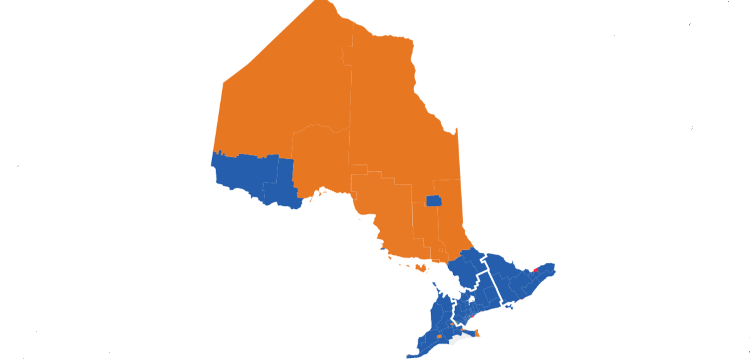
In the wake of a provincial election that handed Doug Ford’s Conservatives a second majority, a lingering question remains: why is voter apathy so high?
Despite 10 days of advance polls that were open 12 hours per day on most of those days, a mail-in option, and a 12-hour voting window on election day, Ontario still saw its lowest voter turnout in history. Early Elections Ontario data from yesterday’s election shows that only about 43 per cent of eligible voters cast ballots.
One wonders what the outcome would have been if voting were mandatory, and the way votes are counted were different.
Let’s look to our Aussie friends for another way.
Australia just had a federal election last month. More than 90 per cent of voters cast ballots, a number typical of all of the country’s elections. Why? One reason is that voting has been compulsory in Australia since 1924, with a small (A$20) fine levied against those who don’t. (The fine can be waived if a voter has a “valid and sufficient” reason for not voting.)
Australia is not the only country where citizens are legally required to vote—Belgium, Brazil, and Peru are among the countries around the world that have some form of compulsory voting.
Australia also has a preferential voting system. Voters rank candidates rather than choosing just one. If no candidate has an absolute majority (more than 50 per cent of the votes), then the candidate with the fewest votes is excluded and the second choice on each of the ballots cast for that candidate are added to the other candidates’ totals. This process continues until one candidate has a majority of votes.
The Australian system ensures that for those voters whose first choice didn’t win, their second (and perhaps third) at least has the chance to be counted.
While the system has its detractors, with some saying that if citizens have the right to vote, they should also have the right not to vote, most seem to accept the system which ensures that no vote is “wasted”.
Contrast that with Ontario, where just 18 per cent of the more than 10 million eligible voters in the province supported the government that will now rule for another four years.
Ontario saw a significantly higher voter turnout in the 2018 election, with 57 per cent of eligible voters casting a ballot. But even then, that translated to support for the winning Conservative party from only about 23 per cent of registered voters.
Or consider the last federal election, which had a more respectable 62 per cent voter turnout, but the Liberals won 47 per cent of the seats thanks to 32 per cent of the votes, representing just 20 per cent of Canada’s 27,366,397 registered voters.
In local polls, MPP-elect Graydon Smith received 45 per cent of the ballots cast on June 2, but that equates to only 26 per cent of registered voters in the riding.
It’s no wonder Canadian voters are disillusioned.
A hat tip to Kai Brach’s Dense Discovery newsletter, where I first learned of Australia’s voting system.
Don’t miss out on Doppler!
Sign up here to receive our email digest with links to our most recent stories.
Local news in your inbox so you don’t miss anything!
Click here to support local news
No, we do not need Australia’s system.
One of the primary motivations for democracy in a liberal polity is the notion of equality. To vote is to express one’s equality of conscience as an equal citizen.
If we are to maintain equality of conscience, we must allow individual to abstain from voting if they do not agree with the ideology of any party on the ballot paper.
An anecdotal story which you may/may not find of interest about voter engagement. You may have experienced the same.
My parents regularly voted; they took and read a daily newspaper, watched “the news” at night on TV. They had no time to attend any scheduled debate, but could watch any offered on TV. When in Grade 8 at provincial election time, our elementary school teacher had students volunteer to represent a mainstream party running in our riding, with a duly volunteered student campaign manager. They were to campaign, present the party positions and priorities in the riding.
My parents, busy with work and care giving to a grandparent in the home, told me – you have a chance to hear about the party positions. Tell us about those positions (party platform) and who you would vote for, and we will take your advice. Was I sophisticated enough to understand all the issues in depth? Of course not. But I could be engaged at home and at school.
However, I shared what I was learning from the work by my classmates. I advised NDP.
Years later, my brother was in Grade 9 or 10 with the same type of exercise in high school. My parents again asked for his input as to party positions and representatives. He advised Progressive Conservative. My parents followed through with their proposal. They allowed us the opportunity to influence their decision-making, for the reasons we provided.
I don’t suppose my story is unique.
Government mandating anything that should be a personal choice is a wrong-headed policy. Since you raise the issue, Anna-Lise, if all vaccines were truly “safe and effective,” who wouldn’t choose to get them? People make choices on the basis of what they feel is right for them, and the Charter of Rights and Freedoms spells out the rights of the individual against the overstep of government. The observance of history, tells us that it is VERY important to safeguard the rights of the individual, in balance with any “collective”. The rights of the individual against the power of the State, has a long and distinguished history (from the days of the Magna Carta) in the English-speaking nations. Shedding it would bring great harm to all. Anyone who has ever lived under communism will tell you that living where the State has the absolute ability to infringe on the rights of the individual, is an awful place to live.
By the same token, when one (rightly or wrongly) believes that his/her vote doesn’t make a difference–that we get who the power-brokers want us to have–should we be surprised by voter-apathy? They had mandatory voting in Soviet Russia, but the only “choices” that the people had were “Politburo Pete” or “Stalinist Sid.” Nearly all were incompetent, corrupt or both.
Only 17.6% of eligible voters gave Ford a “majority.”
41% of the only 43% who voted.
Staying silent and hiding from the press obviously works.
I disagree with mandatory voting simply because the only thing more dangerous than apathetic voters are uninformed voters. Just because it is mandatory to vote doesn’t necessarily mean voters will make the effort to educate themselves about the issues.
Suggestion : The voting system needs to change to make it more convenient via using the internet. You can get all your fed docs and services via the internet based on SIN #, Province, PIN. You can do all your banking via internet and buy everything via the internet. Surely those in power can come up with a voting system using the internet. Most of the work is already done .. just add a voting function/option based on sin#, province and pin .. problem solved!
As a Canadian who grew up (and previously voted) in Australia, I know the Oz system is not ideal. It allows two minor parties to exchanges votes to prevent the most popular party from winning. So, instead of the most popular party who might have garnered 48% of the votes, the coalition of two smaller parties could win with 52% of their added votes. Not exactly the same as in Canada where the most popular party can still win and govern with temporary alliances with other parties. Neither system is ideal, but that’s democracy for you!
Hello Dawn; Can’t help but note the irony. Your question/point about mandatory voting, while Conservative PP tables a motion to end mandatory vaccinations in the Federal House of Commons.
1] Why some do not cherish the opportunity to vote passes my understanding. Is there a lost sense of the collective in what we do? Why the lack of recognition that we are interdependent as human beings?
Individuality is on steroids that we don’t/can’t acknowledge our collectivity/community – this to our joint peril, in my view.
2] What would PP’s motion portend? A possible welcome to any/all communicable illnesses and diseases for Canadians?
Welcome back small pox, measles, TB, Ebola, any and every Flu virus, etc., etc. Let’s infect everybody so I can choose to be vaccinated in a pandemic. Wow. A very quick human extinction in the cause of individual rights and freedoms. An extreme of “survival of the fittest” philosophy, individuality at its most foul.
Just maybe if they had a much better place to vote in Huntsville anyway the turn out would be better. My card said the better living center down stairs but when I got there the signs said vote here but the only people there were a few guy’s playing music and no one knew where we should go so I drove around the building looking at all the doors no sing saying vote here on any door. Finally went into the snack bar and asked them no one knew. Then a couple of boy’s I’m guessing from high school showed up and said they thought it was upstairs and sure enough that is where we found it. It’s a good thing the elevator was working that day because i’m a bit disabled and would not have been going up the stairs Someone posted the other day that about the same thing happened to them but the elevator was not working so they left, All in all it was about the worst explained voting place I have ever seen.