
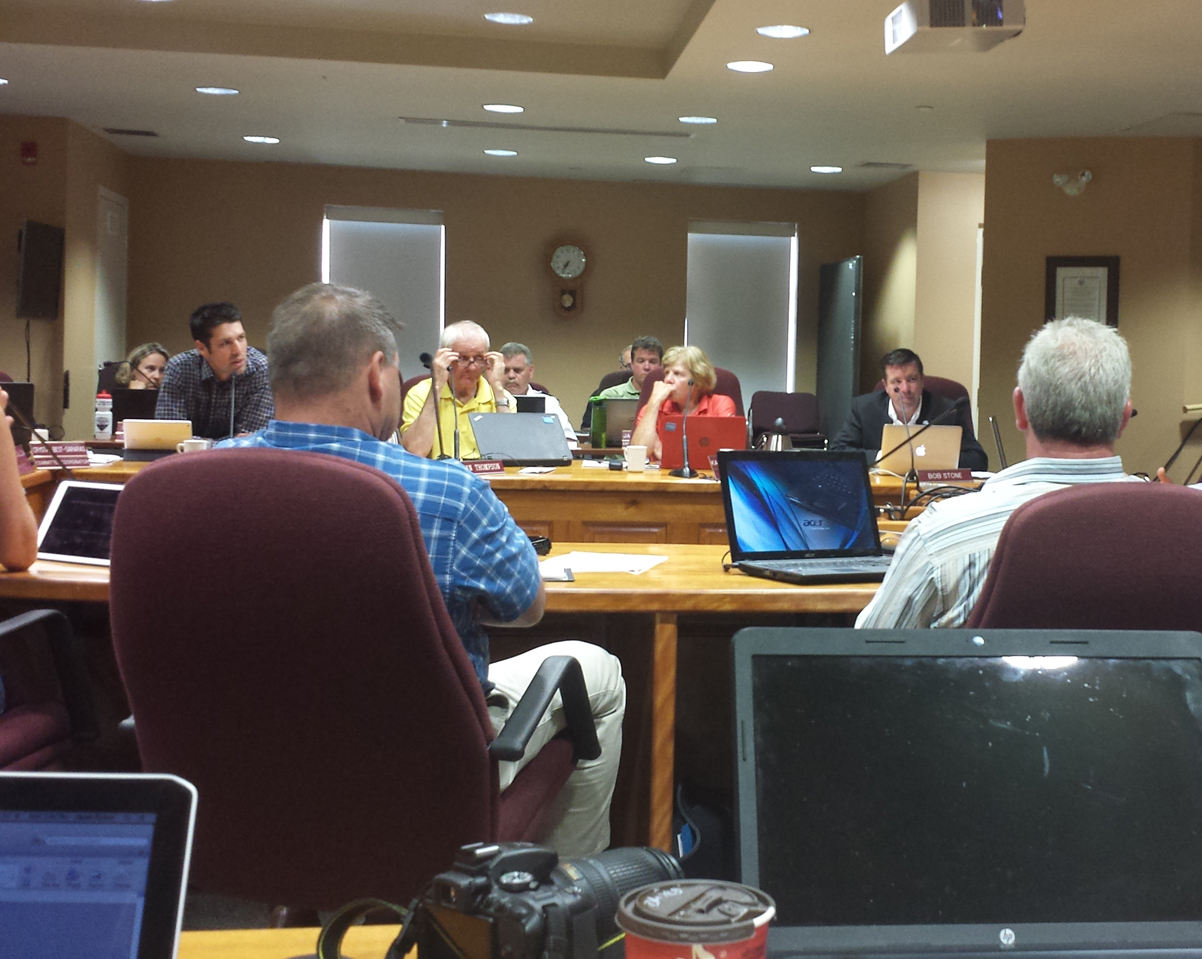
Huntsville Council is expected to kick around the idea of making allowances for those who own properties on flood plains – at least to enable property owners to enjoy their property on a seasonal basis.
The issue is expected to be discussed further at the Town’s General Committee meeting on Wednesday, June 29. It comes at the heels of an application brought forward to Huntsville’s Committee of Adjustments on June 15, whereby a property owner asked the committee to let him keep his trailer on a higher point on his property, which is located in a flood zone. In the end, committee denied the request but not without some trepidation. See the initial story here.
“There was much discussion around the table that these properties should be reviewed,” said committee chair and Councillor Bob Stone. He added that as the Town undergoes a review of its Official Plan, consideration ought to be given to such properties.
“I think the committee really wrestled with the concept that they have this property and they can’t build and your neighbours are upset. They can’t have even an RV,” said Councillor Nancy Alcock, referring to the Town’s current bylaws, which do not allow any type of structure in flood zone areas except for those properties which are grandfathered. “It just seemed like this could be one of many properties,” she said, adding that the time to review the municipality’s policies is precisely during the OP review.
Councillor Jonathan Wiebe took it a step further and said he’d like the issue discussed around the council table at the Town’s General Committee.
I think that it’s important that we all have a chance to discuss it together. There are options that we alluded to during the meeting that may be a good compromise and that would be seasonal occupation of said lands. So I think there’s a bigger discussion still to be had.Huntsville Councillor Jonathan WieBe
He will be bringing the issue to General Committee for further discussion in the hopes of coming up with an interim solution. “It’s a financial hardship when their own property can’t actually be used even when it’s not during flood watch,” he said.
I have never seen so many diverse and convoluted responses to what is, in essence, a simple question: If a vacant lot is not “grandfathered”, should it be categorized as “SR” (Seasonal Residential)?
If so, simply indicate restrictions with respect to dates and type of occupancy. If not, perhaps the Town should use some of the “in lieu of greenspace” monies gleaned from developers over the years to purchase the property as parkland.
Of course, subsequent to the latter action, do you try to recoup the expenditure from the real estate agent of record, or is it just an unfortunate case of “caveat emptor”? And what is the Town’s liability for personal safety for visitors to the property during a heavy spring freshet?
A difficult decision for sure. Here are a few things to think about.
The problem seems mainly two fold.
FIRST is life safety. How do we ensure that nobody ends up trapped and dead or injured due to a flood? Moreover how do we do this without constantly putting our EMS services to work for every flood? They are already busy at such times and we still need them for “other” emergencies, they cannot all go moving flood victims from an area that we know for sure will flood first every time.
SECOND is property damage. How to prevent damage and pollution during a flood.
These sound straight forward enough issues but they are compounded by the grandfathering of what in this case amounts to “past mistakes”.
It seems somehow unfair to charge taxes on a piece of property upon which the owner can do virtually nothing.
On the other hand it is equally unfair to expect the rest of the community to constantly “bail out” (almost literally) owners who have built unsuitable structures in an untenable area.
Not allowing any further development in these flood plains seems to make good sense.
Perhaps if the owner of a grandfathered lot could demonstrate that what they wish to build will be “flood proof”, that is it can survive any flood undamaged, then they should be allowed to proceed.
It would be pretty costly, requiring piles and raised structures with all services arranged to also survive a flood so most likely not many owners would opt for this solution but it could be left there as a final option for those who just love their flood prone property.
One has to admit that for most of the year these properties are quite nice. It is just for a few weeks per year that there is even risk and some years no flooding occurs at all.
If the owner can demonstrate, with suitable engineering data, that what they have or want will neither be damaged by a flood, not release significant pollution during a flood and if they accept that there is no insurance or community financial support for their property then what harm is there in letting them use the property?
If the community is not willing to go this far, then they should just get appraised values, buy the properties, (all of them) and remove all structures once and for all and return the land back to nature, where it probably should have been left in the first place. This will be costly and will put people off the land they already own so it may not be popular but it is the ultimate solution perhaps.
I doubt that flood control structures and plans would be 100% effective in this area no matter how much money was spent and the damage to the environment generated by such structures would far exceed the economic worth of the project. Not likely a viable idea.
Just some food for thought.
This is a difficult decision for the Town and resident. I was at the edge of the Etobicoke Creek watching Fireman, swimmers and concerned people try to rescue people in spite of life and danger to themselves. I will never forget that night! The creek was less than 10 wide most of the time and usually not 3 feet deep who would have ever known what damage would happen. The “Village ” was very pro active and decided to remove all people from the flood plain area and created a park. It is enjoyed by many residents and visitors each year. Think about the discussion you are having. I would not like to ever see that happen in our town and the municipality be responsible for not making the tough decisions. !00 year floods do occur.
Let’s hear from the residences that live here on the Big East, I for one have been here 14 yrs. I have 75 ft. of water front and pay just shy of $2,000 in property tax, live on private rd. no amenities and during the big flood of 2013, we the affected river people had to raise the money in order to get any help from the town, I believe they did match the small amount raised. However the government funding was used for roads, public beaches, town docks and anything tourist related. P.S. with this kind of property tax, why the hell not permit a trailer.
There seems to be a big difference between pitching a tent or even parking a trailer and then building a permanent patio around it – that doesn’t seem very temporary. Yes, they pay taxes, and so do the rest of us, and who pays when they have to be rescued from the flooding that occurs now very randomly.
Perhaps the town can appropriate all those living there and do what ever they choose to do with it then.
I must respectfully disagree with the analogy that “if it is not o.k. in one particular location with our American cousins, it should not be o.k. here with us”. These property owners pay taxes and have made a considerable investment in our community. Tourist dollars have been and continue to be the staple of our economy. At the very least they should be able to park a trailer or pitch a tent on a seasonal basis! Subsequent to our spring melt, I am unaware of any “flash flood” ever occurring on the Big East River. For one to occur, we would have to have non-stop torrential rain for days. That, in itself, would be fair warning. At the very least, Council should permit seasonal residents on a “no liability – no recourse” basis.
No no no. Flood plains are flood plains. After Hurricane Hazel NO ONE was allowed to remain on the flood plain. West Virginia (after a century of floods) is at last discussing the same thing. Bite the bullet, council.