
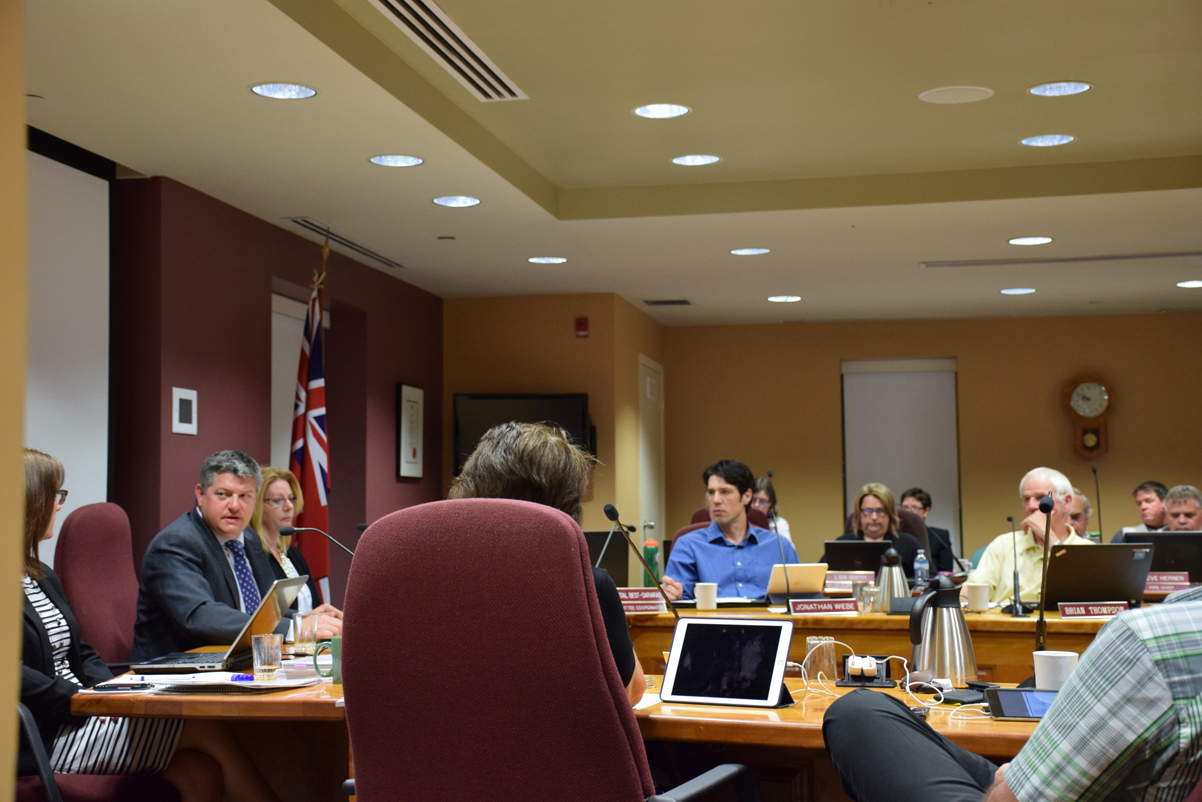
Debates about the composition of council at the District Municipality of Muskoka are expected to move forward. It comes on the heels of complaints by township representatives who argue that they do not have an equal voice around the table.
There are currently 22 councillors, plus the District chair, who sit at the District Municipality of Muskoka council table. Each of Muskoka’s three towns have four representatives as does the Township of Muskoka Lakes while the townships of Lake of Bays and Georgian Bay each have three.
“Interestingly enough, any change in council composition requires a two-thirds majority of the municipalities and the number of electors in Muskoka as well,” Huntsville Mayor Scott Aitchison told his fellow Huntsville councillors at their May 24 meeting.
He warned that any changes at the District could have an impact at the local level as well.
Any changes to the composition of District council might affect the composition of this council. I think it’ll be a very interesting discussion about how many people should represent who exactly, whether it is permanent residents, seasonal residents, electors, all citizens…. Huntsville Mayor Scott Aitchison
Changes at the District would likely open up discussions about the number of Huntsville’s own wards and who represents those – especially if the push to decrease the number of representatives at the upper-tier municipality is successful. How the District chair is elected is also up for discussion. Currently the chair is elected by District councillors. Arguments have been made for quite some time for the position to be elected at large, but opponents have said the cost of such an election would be prohibitive.
District staff has brought two reports forward. One deals specifically with the requirements associated with changing the governance model, while the other provides background information about the current model as well as alternatives. You can see those reports here and here.
Don’t miss out on Doppler! Sign up for our free, twice-weekly newsletter here.
It would be interesting to know the cost of the two reports linked at the end of the article; as their net effect was to maintain the status quo. I would suggest that this is clearly not an option. Several comparable area municipalities (far larger than ours) have instituted in-depth reviews. How is progress served by burying our heads in the sand?
Without going into great detail concerning the reviews carried out by Durham, Peel and York; I make these observations.
1) Durham used a consultant for nine (9) months, without significant direction, to arrive at minimal change. This cost is unjustified for them, and beyond anything to be borne by Muskoka taxpayers.
2) Peel formed a task force, whose composition I felt was beyond reproach. They were charged with responding to several pertinent questions with the assistance of a formal facilitator. As a qualified ‘informal’ facilitator, who has often watched my superiors in action, I vouch for this method.
3) York’s review was quite similar to Peel’s. They did not, however, indicate the composition of their task force. They also used a facilitator and will respond to key questions.
Personally, I favour the composition of Peel’s task force, the use of a facilitator, and questions uniquely appropriate to Muskoka. As a proponent of the Carver method of governance, furthermore, I would like to see the number of District councillors reduced to seventeen (17): An uneven number allows the councillors to decide most motions, but also allows the Chair to vote to cause a tie in very close votes.
Two additional items worthy of consideration are whether a two-thirds (2/3) majority should be required for a vote of this nature and import, and whether considering permanent residents as the representative population may be considered to be equitable.