
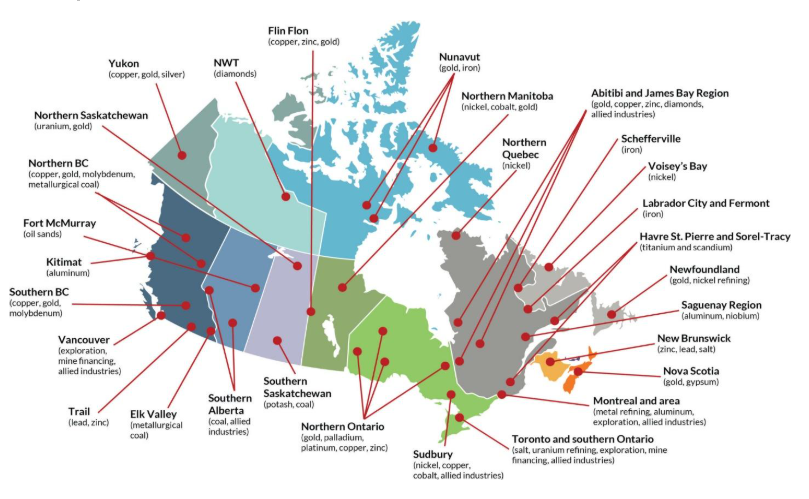
In the 2025 UN survey of global resources, the richest countries by natural resources hold vast reserves of the world’s most valuable commodities—oil, natural gas, coal, metals, timber, and minerals. These nations possess immense stored wealth that plays a crucial role in shaping global energy markets, geopolitics, and economic strategies.
Shown below are the top 10 countries. Thanks to our expansive forests, oil sands, and mineral reserves shown above, Canada is 4th in total value and second only to Saudi Arabia in value per capita. Canada has the most diversified set of natural resources, a stable government, and an education system to turn out the engineering, financial, and skilled trades talent needed to mine these resources and turn them into manufactured products.
| Country | Resource Value | Population | Value per capita | Diversity (types of resources) | |
| Saudi Arabia | $ 34 trillion | 34,566,000 | $983,796 | 3 | |
| Canada | $33 trillion | 40,126,000 | $822,942 | 13 | |
| Australia | $20 trillion | 26,974,026 | $743,494 | 5 | |
| Russia | $75 trillion | 143,997,393 | $520,833 | 6 | |
| Venezuela | $14 trillion | 28,516,896 | $490,935 | 3 | |
| Iraq | $16 trillion | 47,000,000 | $340,425 | 3 | |
| Iran | $27 trillion | 92,417,000 | $292,207 | 4 | |
| USA | $45 trillion | 347,275,807 | $129,682 | 6 | |
| Brazil | $22 trillion | 212,812,405 | $103,383 | 5 | |
| China | $23 trillion | 1,416,096,094 | $16,242 | 4 | |
But our proven oil and gas reserves account for $27 trillion or 82% of the total $33 trillion in stored natural resource wealth. And the nature of our heavy oil makes it the biggest single source of Canada’s climate-changing carbon emissions. So, the thing that ranks Canada as the second biggest in resource value per capita also ranks us as the second biggest source of emissions per capita.
The continued use of fossil fuels is driving up the cost of housing and food in all countries. Scientists say that climate change, driven by the burning of fossil fuels, has created drier landscapes and longer fire seasons, sparking food-crop losses, more intense and widespread forest fires, and more costly tornadoes and floods.
Fire is a natural part of the forest lifecycle, but for many tree species, it can take 70 to 80 years for a burned-out forest to return to normal production of commercially viable timber. More than 7.3 million hectares have burned in Canada so far this year, more than double the 10-year average for this time of year, according to Natural Resources Canada. At the rate of 7.3 million hectares for 70 years, 511 million hectares (5 million km2) could be rendered non-productive. That’s more than half the area of Canada or the USA.
Since the re-emergence of Donald Trump and his insanely selfish, ego-driven thinking, the world has turned upside down. Previous global efforts to mitigate climate change have been pushed aside by Trump’s scheme to reduce US debt with tariffs on other countries rather than fair taxes on the 850 US billionaires who control him. Putin and other short-sighted characters are trying to take advantage of Trump’s mass confusion.
Given that the world will need Canada’s oil before global reserves are depleted over the next 4 decades of energy transition, and given the rapid advancement of climate change as evidenced by the increasing incidence of extreme heat waves, wildfires, tornadoes, and floods, emissions from oil sands extraction must be and can be addressed.
Canada will need one or two more major pipelines to help supply an energy-dependent world, but we must not ignore the urgent need to cap and reduce the resulting growth in oil sands emissions. The primary source of oil sands emissions is the wasteful burning of natural gas to melt the bitumen underground, so it can be pumped to the surface for processing and shipping. Gas can be replaced by geothermal heat from Alberta.
Small Modular Reactors can double the bang for the buck. They can provide zero-emission heat to replace the burning of natural gas for melting bitumen, and at the same time, they can co-generate electricity to replace the burning of natural gas for the Alberta electricity grid. But that will take some time, and it will take money from oil industry profits as well as from the benefitting Alberta and federal governments. In the meantime, the industry needs to go flat out on CCS (Carbon Capture and Storage).
Hugh Holland

Hugh Holland is a retired engineering and manufacturing executive now living in Huntsville, Ontario.
Don’t miss out on Doppler!
Sign up here to receive our email digest with links to our most recent stories.
Local news in your inbox so you don’t miss anything!
Click here to support local news
Thank you, Hugh, for such a thoughtful breakdown of both the opportunity and the challenge Canada faces with our resources. The balance you point to — meeting global energy needs while tackling emissions — is exactly where our country’s leadership is focusing now. It’s encouraging to see Canada working with allies like France and the UK on the world stage, while also looking at smart solutions at home like CCS, geothermal, and modular reactors. We really do have a chance to lead by example.
Bob Braan, Spain is a high sun country. Solar is 4.2 % of their Total Energy Supply. The highest of any developed country. Denmark has the highest % of Wind energy at 8.5% of TES. Denmark is a pennisula surrounded by wind turbines in a shallow sea. Wind and solar can make a valuable contribution but it is highly unlikely they can ever be anywhere more than 15% of TES in any country. Storage is very expensive. France has the highest % of nuclear at 41% of TES. Remember that electricity is currently only 20% of global TES and fossil fuels are 80%. Lets meet for a coffee and look at some data from the International Energy Association.
Green energy and storage are the least expensive and most reliable sources of power now. As the cost of solar, wind and batteries continues to plunge. Expensive, unreliable fossil fuel power is becoming less and less relevant. As the world switches to EVs refineries that used to supply gasoline are shutting down in China, the UK and California.Peak oil demand is coming sooner than predicted. 2027 in China as they rapidly switch to EVs..
A discussion of the future of energy should include batteries.Batteries not only make green energy available 24/7 but they can prevent power outages due to unreliable fossil fuel and even nuclear plant failures costing millions.
It’s interesting to compare forward thinking, oil rich Texas with backward thinking, oil rich Alberta. Search “Batteries save Texas after coal plant fails during worst heatwave in decades” After a nuclear plant failed the week before that as well.
16 GW of battery storage in Texas next year. Up from 8 GW right now.
More renewables installed in Texas in the next 3-5 years than the rest of the US combined.
“A heat wave hit New England’s grid. Clean energy saved the day.On the hottest day this year, behind-the-meter solar panels and a growing network of batteries helped prevent blackouts and saved consumers millions of dollars”
And in California “Battery storage becomes biggest source of supply in evening peak in one of world’s biggest grids”
But Dani Smith in Alberta claims batteries are too expensive. She also claims heat pumps don’t work.
While the lights went out Apr 5 in Alberta due to no grid batteries when unreliable fossil fuel plants failed.Multiple outages and grid alerts since then.
Ontario is putting in 3 GW of grid batteries by 2028.
12% of peak demand. Huge.
On a smaller scale ” Home batteries are saving America from blackouts.” We have a small, silent, inexpensive battery backup system in the basement instead of a noisy, GHG spewing generator outside.Have used it quite a lot in the last year due to the many outages.I could put in more batteries but will likely wait and get an EV.Huge EV batteries can power your home for a week. Many EVs come with 120 volt and even 220 volt outlets.
CCS is a dead end. Money pit.
“Oil Companies Know Carbon Capture Is Not a Climate Solution””Don’t Fall for Big Oil’s Carbon Capture Deceptions””CCS has become a tool for the fossil fuel industry to maintain its operations while appearing environmentally responsible, rather than a genuine solution for climate change.””Carbon commentary Is CCS really the answer?”
Bob Braan, Geothermal is a good option for replacing natural gas for melting bitumen, but not sure it is always hot enough to co-generate both industrial heat and electricity. There is no doubt about SMRs ability to do that. If Daniel Smith and the Alberta oil and gas industry want federal money to build pipelines, they must cooperate on reducing Canada’s single biggest source of emissions. We have all seen the data on the rapidly escalating killer heat waves, wildfires, etc. By clinging to fossil fuels for too long, the world is sleep-walking into a double catastrophe, an unlivable climate and the inability to ramp up other sources of energy before we run out of fossil fuels.
You can’t be for real. Seriously ?
Green energy and storage are the least expensive and most reliable sources of power now.
Nuclear is the most expensive. It never was on option for poorer countries. Unlike green energy.
Nuclear is far too expensive and takes far too long to build.
Going way over budget and schedule is typical.
Search “French giant cancels nuclear power plant and turns off 6 nuclear reactors.”
There used to be a lot of hype about SMRs. Now not so much.
“French nuclear giant scraps SMR plans due to soaring costs, will start over”
“Eye-popping new cost estimates released for NuScale small modular reactor”
Which is why it was cancelled. That was the one and only SMR certified in the US.
All because renewables and storage are far cheaper.
China used to think new nuclear had a bright future. Now, not so much.
Search “China’s quiet energy revolution: The switch from nuclear to renewable energy | RenewEconomy”
Search “China is installing the wind and solar equivalent of five large nuclear power stations per week.”
Because green energy and storage are the cheapest source of power now.
Not just to reduce emissions and reduce health care costs due to smog.
Alberta is not interested in clean 24/7 geothermal energy.
Germany is.
Search “Eavor Enabling Local Energy Autonomy… Everywhere”
They are based in Alberta but are completing a demonstration project in Germany.
Unlike most areas, Alberta is lucky enough to have easy access to non-emitting, reliable 24/7 geothermal power.
“According to the Canadian Geothermal Energy Association, there is a geothermal resource potential of 388,500 megawatts (MW) in Alberta. Geothermal electricity generation is nothing new, but it is new to Canada’s energy industry. Canada is the only major country on the Pacific Rim that isn’t using its underground thermal resources to produce energy, and it isn’t due to the lack of potential. Alberta’s hot springs indicate that there are clear access points for harvesting geothermal energy here, and that is one of the reasons Alberta is considered to be one of the provinces that could profit most from geothermal energy generation.”
But Dani Smith prefers far more expensive GHG spewing nat gas.
And so do her fossil fuel masters.
Quaise Energy is another company that claims their ultra deep, ultra fast drilling method makes geothermal power available everywhere.
Search “In Texas, ex-oil and gas workers champion geothermal energy as a replacement for fossil-fueled power plants”
But not Alberta.
Nice idea using SMRs to reduce emissions from the oil sands but fracked shale gas is also problematic for producing methane and increasing climate changing pollution. Not seeing a lot of action from the Oil and Gas industry to produce a product that is not harmful to environment and human health – even to air quality in our homes. Not convinced that taxpayers money should be assisting them to continue to do so. ( building pipelines etc. )Seems to be another “harm reduction” strategy we are being sold to prop up the fossil fuel addictions that we have – including plastics and now microplastics ( byproduct of fossil fuels) entering our bodies.Instead we need much more investment in energy alternatives and solutions to adapt to the now inevitable human caused climate events- heat, drought fires and floods. Globally and in Canada( Lytton, Jasper, northern communities) people dead, homeless and displaced by these events. Are we waiting for it to happen in the GTA before it counts as “real”?
Right on Hugh. As always, a step ahead of the rest of us!
Don Sinclair
[email protected]