
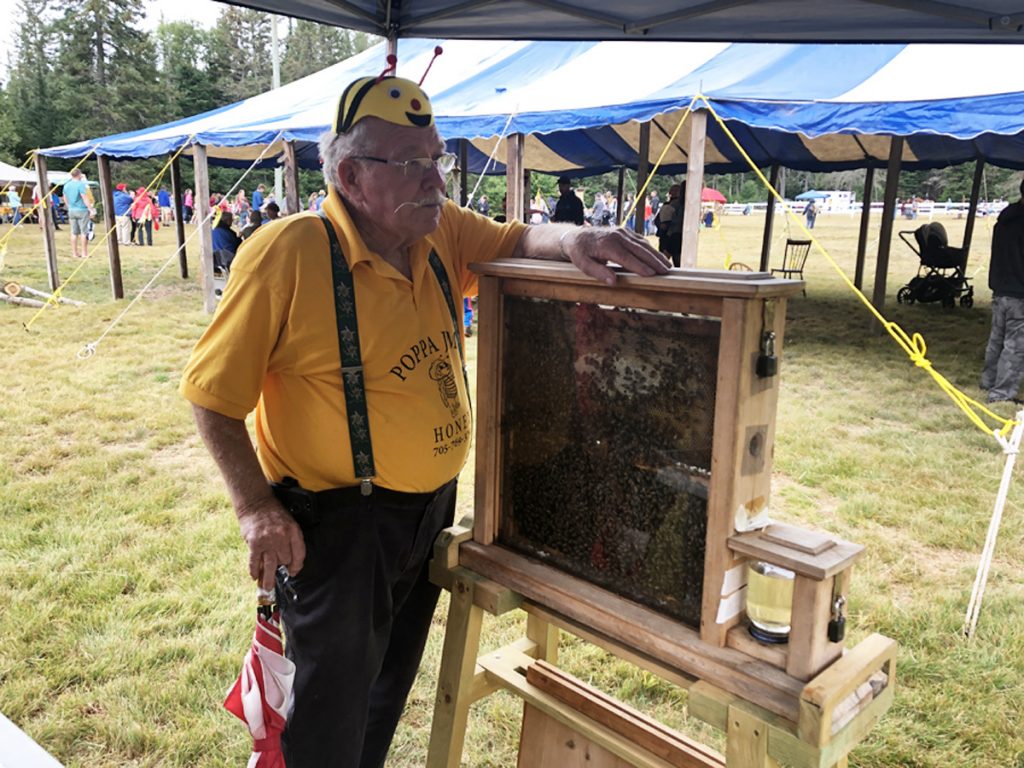
The governments of Canada and Ontario have announced that they are increasing funding to the Honey Bee Health Initiative by up to $1 million to help improve the resiliency and competitiveness of beekeeper operations in Ontario.
They say the additional funding will help more Ontario beekeepers better protect their colonies over the winter and protect against invasive pests such as varroa mites, which pose a serious threat to honey bee health.
“So many of the crops grown across Ontario depend on healthy bee populations,” said the Honourable Lawrence MacAulay, federal Minister of Agriculture and Agri-Food, in a press release on May 21, 2024. “We’re expanding this vitally important support for our beekeepers so they can safeguard their livelihoods and keep their honey bee colonies healthy and sustainable.”
The Honey Bee Health Initiative, made possible through the Sustainable Canadian Agricultural Partnership (Sustainable CAP), opened on September 15, 2023, with a budget of over $1.3 million. According to the release, 218 projects have been approved to date. This initiative builds on previous programs, such as the back-to-back Honey Bee Health Management initiatives offered under the Canadian Agricultural Partnership (CAP).
“Honey bees play an important role in our agriculture and food industry as well as in Ontario’s ecosystem,” said Lisa Thompson, Ontario Minister of Agriculture, Food and Rural Affairs. “This increase to the Honey Bee Health Initiative demonstrates our governments’ commitment to the bee sector and production of honey throughout the province.”
This initiative, delivered by the Ontario Soil and Crop Improvement Association (OSCIA), will directly contribute to the goals outlined in the Grow Ontario Strategy. Its outcomes are expected to help support food supply chain stability.
“Ontario’s beekeepers and the honey bee industry are integral parts of Ontario’s food supply and food security,” said Ian Grant, President of the Ontario Beekeepers’ Association (OBA). “The OBA welcomes the Ontario government’s further investments into our industry, and thanks Minister Thompson and the Sustainable Canadian Agricultural Partnership for their continued support.”
Sustainable CAP is a five-year (2023-2028), $3.5-billion investment by federal, provincial and territorial governments to strengthen competitiveness, innovation, and resiliency of Canada’s agriculture, agri‐food and agri‐based products sector. This includes $1 billion in federal programs and activities and a $2.5 billion commitment cost-shared 60 per cent federally and 40 per cent provincially/territorially for programs designed and delivered by the provinces and territories.
Quick Facts
- Ontario beekeepers can apply for cost-share funding under the initiative as of June 3, 2024 and the intake will remain open until funding is allocated.
- Up to 50 per cent of the costs of approved projects may be funded under the initiative. Ontario beekeepers with fewer than 50 colonies are eligible for up to $4,500 total on approved projects and beekeepers with 50 or more colonies are eligible for up to $25,000.
- Eligible applicants will be required to provide evidence of completing a pest management course related to Ontario honey bees from a recognized institution.
- The Grow Ontario Strategy is the province’s plan to strengthen the agri-food sector, support economic growth, and ensure an efficient, reliable, and responsive food supply for Ontarians.
Don’t miss out on Doppler!
Sign up here to receive our email digest with links to our most recent stories.
Local news in your inbox so you don’t miss anything!
Click here to support local news
A few tears ago a swarm of honey bees landed on a tree next door. We contacted a person that knew poppa Jim. Jim came and patiently waited and got the swarm into a box. During the time Jim was here I learned a bit about honey bees. The most interesting thing was that Jim said honey bees are not a native species. So go figure, did honey bees replace or displace another pollinator?