
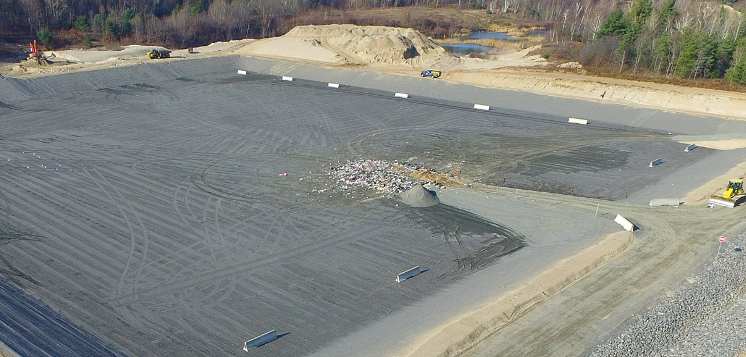
The District of Muskoka continues work on its Solid Waste Master Plan, a strategic guide for how Muskoka can achieve its waste management goals over the next 30 years.
The plan is critical because as Muskoka’s population grows, its landfill space is decreasing.
At their August 21, 2025, meeting, District councillors were told that half of the plan has been completed by District staff and consultants. The final plan, following more consultation, is expected to be presented to the District Engineering and Public Works Committee in mid-2026.
While the key priority is to prolong the life of the Rosewarne Landfill through diversion, the plan will explore options for waste disposal once space at the landfill has been exhausted. The community and councillors will also be presented with the options and costs of incineration, burying, or transporting the waste elsewhere.
Another aspect of the plan is expected to address greenhouse gas Emissions. Councillors were told that both closed and open landfills generate huge amounts of emissions, and to mitigate climate change, in anticipation of Federal regulation, those emissions need to be addressed.
Other aspects expected to be explored include whether any services should be extended to the institutional, commercial, or industrial sector, as well as the associated costs.
The plan is also expected to explore funding models for service and infrastructure related to waste processing and disposal.
Councillors were told that, based on the metrics associated with the drafting of the plan, in 2024, Muskoka residents generated 275 kilograms per person per year. Councillors were given an exercise and were asked to indicate how aggressively they want to get to a zero-waste, waste management system over the next 30 years.
The options were Conservative, Moderate, or Aggressive. For example, under the Conservative option, the goal would be to reduce the per-resident waste output to 125 kilograms per year in the next 30 years.
The majority of councillors chose the Moderate approach. Defined by the report compiled by staff as “Take a progressive path, adopting best practices to address the District’s needs and challenges and achieve meaningful improvements, deferring cost increases associated with alternative disposal options.”
Public engagement sessions will begin in mid-September, and the council will be presented with further details related to the Moderate option as well as cost.
Councillors were told that based on 2024 diversion rates, the lifespan of the existing landfill is about 16 years.
Want to know more? You can find staff’s report HERE (pdf) and the presentation to council, HERE (also pdf).
Don’t miss out on Doppler!
Sign up here to receive our email digest with links to our most recent stories.
Local news in your inbox so you don’t miss anything!
Click here to support local news
I feel that we as consumers are set up to fail. I’d love to create less waste but even if I never purchased another item of clothing or object, I still have to purchase food. Our food comes packaged in garbage. If you expect us to stop making garbage, you need to stop giving it to us. Our cucumbers come wrapped in plastic, for goodness sake!
And we are all now using paper straws, wooden cutlery and reusable bags but the big companies out there are still pumping out junk we don’t need wrapped in layers upon layers of packaging. It doesn’t make sense.
When I was a kid we took our garbage to the local dump – Sparrow Lake Route C – we through it off the top of an embankment in to the smoldering pile of garbage at the bottom. It was great fun.
Someone managed the fires and kept it going to ensure stuff for burnt. We need to return to the old ways. (Of course in those days there wasn’t much plastic…pretty much everything burned or melted down)
This country needs to get more incinerators or use cement kilns ext.
For garbage, if you burn it hot enough very little emissions are released into atmosphere. We need to look at the way Europe operates when it comes to disposal of garbage, just burying it in the ground out of sight out of mind idea is 18th century.
Garbage diversion has hit Go Home Lake water access property owners hard. Our ability to deliver our garbage to bins, when it is convenient, has been taken away. Now we must make a special “garbage” trip to a garbage truck waiting at one of our marinas for a few hours three times a week. Has nobody considered the enormous amount of fuel, wear and tear, expended for this special trip, not to mention extra pollution and the danger for 400+ boats arriving through a narrow passage and then idling while awaiting a landing place at a dock that accommodates 3-4 boats at a time? All of our submissions to the District of Muskoka have been ignored by people who have never even visited our lake to see the difficulty firsthand.