
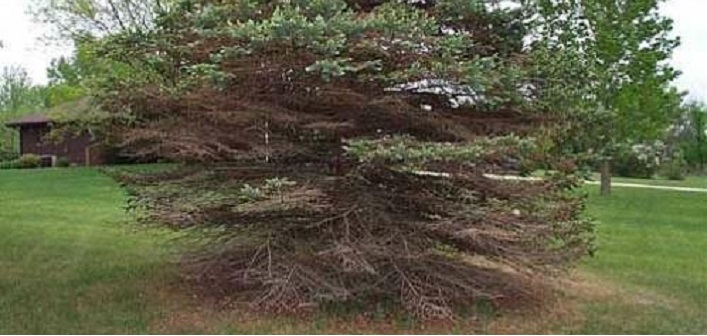
It’s taken a while to get a response but according to Huntsville Manager of Parks and Cemeteries Colleen MacDonald, the disease afflicting the two spruce trees that were removed from River Mill Park was needle cast disease.
According to a fact sheet compiled by the University of Guelph’s laboratory, needle cast is a fungal disease. Most infections usually begin in spring and symptoms arise in late summer. The tree’s lower branches are usually impacted the most with the disease eventually making its way up the tree. “Branch dieback can occur after 3 to 4 years of successive defoliation. Needles shed and branch dieback can create holes amongst healthy branches,” according to the university.
“It was not just that condition that had us make the decision but also the water table in that area is quite high, the soils aren’t great and just the fact that we saw them start to decline, we knew that they weren’t going to improve,” she said. MacDonald added that the decision was not made lightly and sadly, she said, there may be two other trees in the park that will suffer the same fate.
“We don’t take the removal of trees lightly but certainly we make sure it is justified when it does have to happen,” she said.
The issue was first raised at Huntsville Council’s June meeting by Councillor Bob Stone who questioned what had happened to the trees. MacDonald clarified that the trees that were removed were not pines, as first reported, but blue spruce trees.
There are other trees of the same species in that park that we’ll watch that (needle cast disease) could also be present in. Unfortunately not all trees live forever but we try to nurture them along as much as possible, because they were planted in their original position for a reason but there are some really challenging conditions in that park – like the soil, the water table, even the foot traffic… that all plays into it.
Colleen MacDonald, Manager of Parks and Cemeteries for the Town of Huntsville
In terms of new trees being planted to make up for those that have been removed, MacDonald said planting after the existing parking area has been turned to green space may be best.
“Personally I was thinking that if that parking area is going to change to green space, maybe we’d be wisest to wait until that’s done to see where the trees would fit best. Because that is going to change a little bit down there, I’m not sure where the grade will wind up but I suspect where the parking is now the grade will be raised slightly to make it blend better,” she said.
Don’t miss out on Doppler! Sign up for our free, twice-weekly newsletter here.
0 Comments