
“Strike up the band” was written by Bruce West and was first published in July 1976 as part of a series called Enterprising Canadians. Thanks go to Anne Collins, granddaughter of Bruce West, for sending us this article.
Looking back upon it now, it seems highly unlikely that today’s more ardent American-baiters, ecologists and defenders of Canadian culture would have known what in the world to do about Charles Orlando Shaw.
In the first place, Mr. Shaw was born in the United States. In the second place, the tannery he built in Huntsville in the early 1900s most definitely polluted the beautiful little river upon the bank of which it was situated. And in the third place, he made a greater contribution to Huntsville’s fame and prestige – and the culture of Canada generally – than any other person who ever lived in that town.
He was a small, nimble-footed man who often wore rubber-soled ‘sneakers’ which, it was said, he used to enable him to slip up more quietly behind some employee who was smoking in the wrong place or just loafing on the job. Mr. Shaw had an abiding distaste for both smokers and loafers.
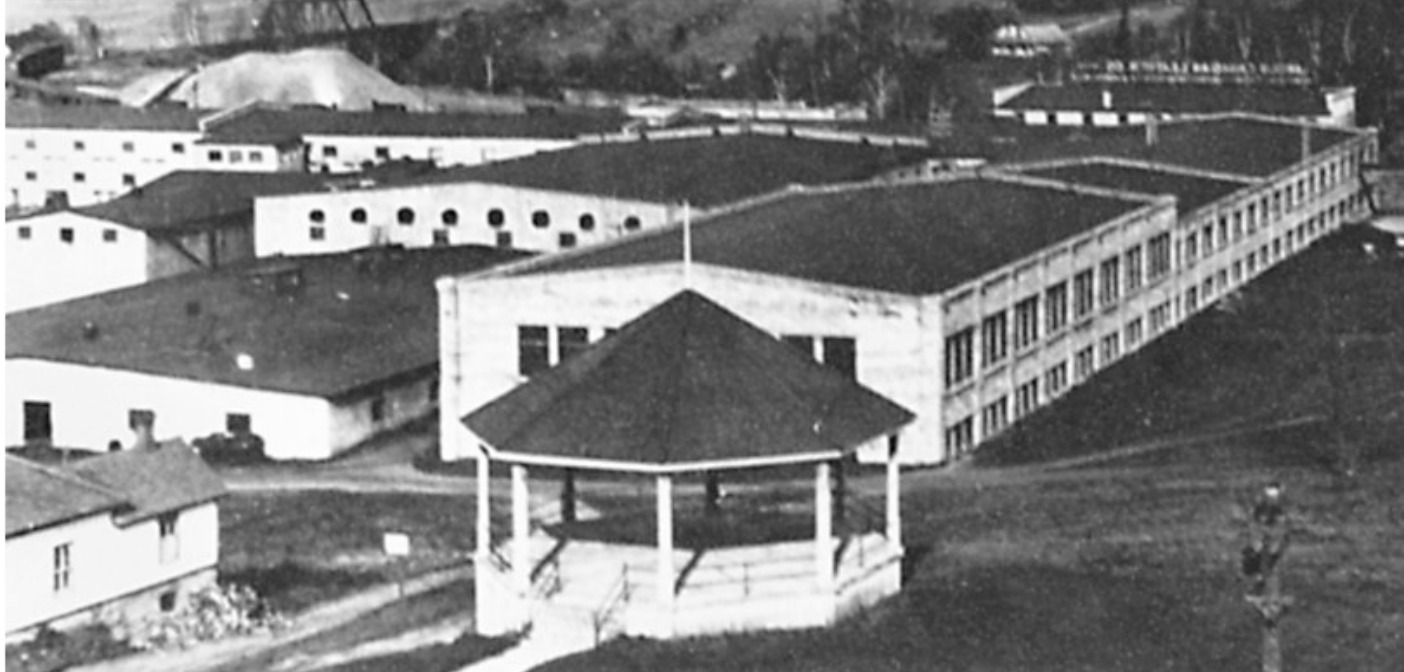
His firm, the Anglo-Canadian Leather Company, employed a large number of Italian immigrants who lived in small and uniform company houses erected in a little valley which became known, rather disdainfully, as The Hollow and was situated within handy walking distance of the tannery. Mr. Shaw himself lived in a large and elegant frame dwelling that was also fairly close to the plant and boasted one of the biggest garages in Huntsville.
It was in this garage that the story began which was a real life version of The Music Man long before anyone ever thought of writing a hit Broadway show about a small town band. According to the legend, Mr. Shaw’s music-loving Italian workmen decided to form a little band of their own. One of the more serious problems in this project was that the musicians had no regular place in which they could practise.

Anglo-Canadian Leather Company Band. CO Shaw is in the front row, eighth from the left.
With some trepidation, a couple of them approached their rather imperious boss about the possibility of using his large garage once a week. To their delight, he readily agreed. But far more delights were to come.
It so happened that Mr. Shaw was a fairly able but somewhat frustrated coronet player, whose attempts to master this instrument were little known outside his own family circle. The astonishment among the members of the tiny Italian band can be imagined, therefore, when the great man turned up in his garage one Sunday afternoon, coronet under his arm and asked quite humbly if it would be all right for him to join them in a few numbers. He soon become an attendant at every practice.
It was not long after this that Mr. Shaw resolved he would form in Huntsville, a little Muskoka town of about 2,000, a really magnificent band. He then went to work on his great plan with typical energy and directness. First, he would need a first-class conductor. Among his phonograph records, he had a few made by Herbert L. Clark, who lived out in California and was recognized as the world’s leading coronet soloist. With incredible brashness, this small-town tannery owner contacted Mr. Clark and invited him to Huntsville as band leader. No less incredibly, Mr. Clark finally agreed.
The rest is musical history. The Anglo-Canadian Leather Company Band became one of the finest concert bands in the world. During such occasions as the Canadian National Exhibition, it shared the great bandshell with such renowned groups as the Welsh Guards Band and the Grenadier Guards Band from Great Britain. Its 100 or more members included a number of musicians who had been stolen from the great ‘March King’ Sousa in the United States. And the diminutive coronet player sitting there among the ranks at the CNE concerts – clad in one of the snappy uniforms worn by the musicians – was none other than Charles Orlando Shaw himself.
With funds obtained from his rather smelly tannery, Mr. Shaw not only bore the heavy expense of supporting his great band, but also built on Bigwin Island in the Lake of Bays one of Canada’s top summer resorts and established a fleet of steamboats which served the holiday country long and well. The tannery is gone now and so are the steamboats, and Bigwin Island has become a kind of large condominium for summer residents.
But there was a time when Huntsville meant to music what Stratford means to the plays of Shakespeare and Niagara-on-the-Lake to the works of that other Shaw. And there are still oldtimers in Huntsville who speak far more often of Charles Orlando than of George Bernard.
– END –
Bruce West was a well-known Canadian newspaper journalist and columnist for the Globe and Mail and Maclean’s Magazine. He was born in a log house in Huntsville in 1912 and started his journalism career with the Huntsville Forester.
Images from Muskoka Digital Archives, a project of the Huntsville Public Library in cooperation with the Muskoka Parry Sound Genealogy Group.
Don’t miss out on Doppler! Sign up for our free, twice-weekly newsletter here.
I would love to hear anything else about Charles O. Shaw and his family.
Herbert L. Clarke wrote 3 alto saxophone pieces for his son, Charles, Jr. -shown in one of the pictures found on line, I believe.
Paul Cohen, alto sax, performed the new editions of them with The Heart of Texas Concert Band May 19, 2024; see social media
Titles are Helen, Valse Caprice, and Lavinia.
Wondering if those could be family names?
Thanks for any information,
Sudie Rogers
210860-3177
Interesting! I would love to hear this recording.
Good stuff; story and comments. I thought C.O. thought up the band idea. Now straight.
There was a cassette tape produced, I think around Huntsville centennial 1986, of the music of the Anglo-Canadian Leather Company Band. If that has not been digitized, I am happy to volunteer to do so.
Signed out a Herbert Clark CD from the library one time: crazy speed player!
That’s a great story Dave. 🙂
Thx Liz for this article. I have seen photos of your gramps and Bruce West in the Forester office with pipes and cigars just a smokin. Mrs. Stewart, one of my favorite teachers of Huntsville Public school, always would read Bruce’s column in class. I believe she taught him and was very proud of it. It would be wonderful if someone wrote a book on C.O. My favorite tale about him was when they are carrying him dead in the casket out of the Church, a voice suddenly says,” how many men are lifting the casket, six, fire two of them! “
This is an informative & fascinating article on C.O. Shaw; an individual who many claim had a very significant economic & cultural impact on Huntsville & surrounding area during the first-half of the 20th century.
On reading & hearing the stories about Charles Orlando Shaw over the years, a number of questions remain in my mind concerning the historical accuracy of the stories.
1] Apparently C.O. Shaw arrived in Huntsville in the fall of 1898 from Michigan (American-born in Dexter, Maine, 1859) in the midst of a major management-labour dispute & was successful in resolving the issues of the day. Did the availability of recently-arrived Italian immigrants to Canada play an important role in resolving this dispute, & later did the formation of the highly successful & well-funded Company Band play a significant role in maintaining harmonious management-labour relations until his death in 1942?
2] Apparently C.O. Shaw was a stanch supporter of the ‘dry’ cause (officially, alcohol was banned at Bigwin Inn during his tenure). What was the source of his willingness to support the temperance movement, which was common during his time?
3] And most intriguing, apparently the covered walkways, know as ‘cloisters,’ at Bigwin Inn were built mostly by skilled craftsmen who were German/Austrian POWs during the Great War, while the historic Inn was under construction. Were the craftsmen in fact actual POWs, or were they recent immigrants to Canada from Germany or the Austro-Hungarian Empire prior to the outbreak of war in 1914, who had been interned as ‘enemy aliens’ under the terms of War Measures Act of 1914? Does documented evidence exist? Either case, it raises questions around ‘how’ & ‘why’ C.O. Shaw had access to these POWs, or internees.
A comprehensive study of the life & times of Charles Orlando Shaw & his impact on the Huntsville community is long overdue. For a young graduate history student, it would be a fascinating focus for a Ph.D. dissertation in Canadian social history. Move over Tom Thomson!
When I was young, my grandfather banged out a column a day on an old Underwood typewriter. I remember his office at his home being filled with an old ham radio, papers, books and the smell of pipe tobacco; with the desk and the typewriter sitting proudly in the centre of the room. If he were around today, he’d be smiling that one of his pieces, written on this old technology was published on the web (proving that good writing endures the test of time and changes) – and he’d be very pleased that it was of interest to readers in his hometown of Huntsville. He never, ever forgot his roots and was always a ‘Huntsville boy’.