
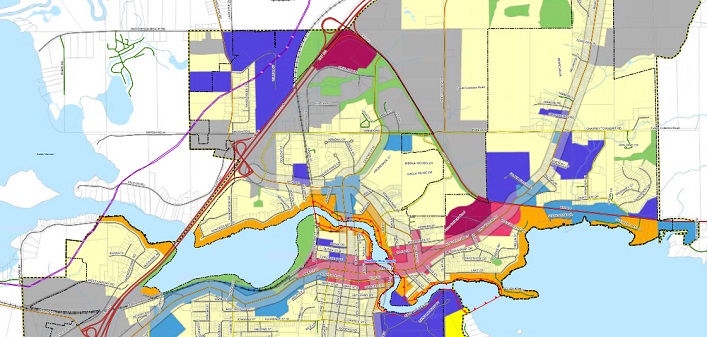
Main photo: A land use map of Huntsville’s urban area. Sections coloured grey are designated for business employment. (Image: Town of Huntsville. See the full map here.)
Should Huntsville residents be able to live where they work, regardless of where that is?
That question arose at a Special Development Services Committee meeting on February 19, 2019, at which committee members addressed items in the draft Official Plan. The Town is currently reviewing its Official Plan, which was adopted in 2006.
As part of the review process, a comment was submitted by Mike Harrower specific to property he owns on Crescent Road but which sparked broader discussion by councillors.
“My main interest is to see if we can develop some ‘live-work’ space or cooperative housing that would compliment [sic] the non-profit cooperative efforts already happening at 1 Crescent and/or some smart value housing (possible zero land cost if we can make the commercial uses carry the cost of the land services),” Harrower wrote in his submitted comment. “I am not looking for a ‘carte blanche’ to do residential on these lands just the freedom to get creative and intensify the use [for] the land without having to go through an OP amendment.”
Mayor Scott Aitchison wondered why there appeared to be concern that if a live-work use were allowed, it might result in a reduction in Huntsville’s designated employment lands.
“It strikes me that that’s a very traditional understanding of how our society works where you live in the suburbs, you drive your big sedan to the factory or the office in another part of town, and the PPS [Provincial Policy Statement, the Ontario government’s policies on land use planning] is specifically trying to discourage that kind of commuting and travelling and sort of tighten up the space between living and working,” he said. “I don’t see live-work space as removing employment lands and I think as well when you look at the way people live, particularly in our community, there’s an awful lot more people that work from home. So how can we address that issue more adequately than this stilted system that says you live here, you work over here, and you play over there?”
The Town’s Manager of Planning, Kirstin Maxwell, noted that the District’s Official Plan requires that municipalities designate lands as employment lands, and that in the new draft Official Plan for Huntsville, it made sense for staff to choose the lands that were already designated as business employment areas for the employment lands designation.
“There are lots of aspects to [the PPS] but one of the things they try to do is make sure that lands that are used for employment purposes remain as employment lands so that there’s guaranteed area for new business to be able to develop and new industry to be able to have space,” said Maxwell. “So one of the goals of the Official Plan is not just to make sure that there’s enough residential land but also that there’s enough employment lands or non-residential lands available…because the last thing we want is to have all our employment lands converted to residential lands. Then there would be nowhere for industry or business to develop.”
But Mayor Aitchison said that didn’t make sense to him. “If we have to identify employment lands, I would suggest then we say that all lands in Huntsville are employment lands. I work out of my house, and the federal tax code permits me to write off a portion of my house because I work there. So we need to come up with a way to address this… to me this is an opportunity to raise the bar, and I see this as a real opportunity to change the way we think of employment lands.”
Councillor Jason FitzGerald added, “My perception is we have a one way street where we are giving people who can afford to buy a home the opportunity to run a business out of their home, but we are not giving small business, which is the foundation of our town, really, and the entrepreneurship the opportunity to live where they work.”
If you have the opportunity to purchase and run and operate a business, if you can live there you are probably 50 per cent more viable. How do we attain that?
Councillor Jason Fitzgerald
Maxwell noted that there are few restrictions for someone wanting to work out of their home, but compatibility issues could arise when there are industrial uses next door to dwellings as recently became an issue on Muskoka Road 3 North. She said that an issue that could also arise would be having employment lands wholly used for residential purposes, as opposed to maintaining a certain amount for commercial or industrial use.
Councillor Nancy Alcock, who chairs the Development Services Committee, said she felt that what’s missing from the plan is the concept of regeneration. “From my understanding, the province is really heavy on maintaining the designation of employment lands because they were losing a lot of them in the area of downtown Toronto. There was a recognition that once you lose them, they’re gone. But they also recognize in the PPS that there are areas that are naturally considered regeneration because the old industry that was there is gone. And so the market itself becomes transitional whether you want to plan for it or not. And to me the Cairns Crescent area is exactly one of those areas.”
It’s not that the Official Plan prohibits living where you work—or vice-versa—but rather it outlines areas that are better suited for business use rather than residential.
Director of Development Services, Derrick Hammond, said that, “In terms of live-work type situations, the plan contains home occupation policies, so that would address the people that are working out of their homes. I think that there’s a variety of designations that would permit accessory residential uses (in a commercial building). He also noted that some of the uses located in business employment areas can’t really be located anywhere else. Industrial properties are a good example. But, he said, “In recognition that there is something special happening in the Cairns Crescent area, staff have created a policy set which would allow for flexible (use) in that particular instance.”
But Aitchison disagreed. “My point though is that the way people live and work is evolving… if somebody wants to live above their shop that they make some small product and market that at the local farmers market and that’s how they make their living, we shouldn’t discourage that.”
So having a map saying this is where you work and this is where you live in this subdivision over here is all well and good, but it’s not 1954 anymore and that’s the model the suburbs were designed on and the provincial policy statement speaks precisely to stopping that kind of development. So all I’m saying is why can’t people live where they work as well?
Mayor Scott Aitchison
To which Hammond replied, “I think for the most part the plan allows that now. The issue here with these types of lands is you have certain types of uses that people don’t want to be next to because they are noisy, they smell…”
Other municipalities are taking notice of the changing employment landscape, and Councillor Jonathan Wiebe said he wants Huntsville to “be on the cutting edge of how the future is going to look in terms of living and working and developing small businesses rather than blend in with all the other places that are allowing a little bit more flexibility with their home-based businesses. I want to be an example in this province of the new face of how small business is evolving. I think this is that opportunity.”
When I look back at how some areas were developed in this community over the last 20 years, I think there were so many missed opportunities at that time… We have created a community that is simply car-centric, and I think that something like this is the beginning of changing the thinking about how we live and work and interact with the community around us.
Councillor Jonathan Wiebe
Wiebe also cautioned about making a distinction “between heavy industrial and employment lands and I think sometimes we conflate the two, because to have a grocery store where people are employed and then to be able to live above it is not the same.”
Hammond reiterated that “the plan is already set up that way and it’s called mixed-use designation. So that is where it is going to be a greater degree of live-work… In business employment, there’s going to be uses there where you don’t want residential uses. So this was a bit of a test case in this particular area [Cairns Crescent] knowing that it’s in transition.”
Staff amended the Official Plan to permit accessory residential use on some lots in the Cairns Crescent area. (You can see the changes on pages 227-228 here.)
Committee reviewed and approved the changes at a second meeting held on February 25, 2019.
The Official Plan Review is nearing completion. Once Huntsville Council has approved the draft document, which could happen as soon as its March 25, 2019 meeting, it will be forwarded to District Council for their consideration of approval.
Don’t miss out on Doppler! Sign up for our free newsletter here.
I totally agree with Mayor Aitchison and Councillor Wiebe: Residential should be able to co-exist with Commercial and Light Industrial. Consider the environmental benefits of reduced CO2 emissions, and the health benefits of walking to work. Also, imagine the uses of the monies saved from the lack of necessity for 2 vehicles (for most). Perhaps you invest in more healthful food, RESP’s, energy-saving options for your home, charitable donations for the less fortunate, etc. It would lead to a more sustainable future for Huntsville.
.
I can’t imagine why the District considers Muskoka to be such a hotbed of new employment opportunities that it would restrict live/work areas unnecessarily. In fact, why not live/work/play areas? Locate the new curling rink in a residential area (as it is now), or maybe include a gym/pool (as well as a park) central to a new subdivision. Flexible housing isn’t news to anybody; but neighbourhoods with either of the above mixes would certainly be attractive to buyers.
We have had live, work, areas since the beginning of Huntsville. Many merchants on Main St. lived over their stores. I have said for many years, we need to not just allow, but to legislate, that low paying businesses like Walmart etc. need to be mandated to build affordable housing units above their stores. Many large plazas in Florida have professional units and housing units above their stores. Things such as gyms, GPs, Dentist, Law offices and the list goes on and on above commercial units. 1 Crescent Road is a perfect example with their hub of where this type of development will work for the developer, the commercial client and those in need of housing. Thanks to Mr. Harrower’s vision, for bringing this important issue before the town’s planning committee.
There are already a few examples, for instance Hwy. 60 around Kelly’s and Three Guys.