
Photography and painting go hand in hand, says Norma Van Alstine.
“Photographing nature is one of my passionate hobbies. Living in Muskoka and within close proximity to Algonquin Provincial Park provides me with opportunities to photograph wildlife and landscapes,” she writes. “More recently, I have been blessed to check my ‘bucket list’ by participating in retreats in Alberta’s Rocky Mountain foothills to photograph the beautiful wild horses that roam free.”
Norma’s wild horse adventure and photographs have been featured in the April/May 2021 issue of Our Canada and Reader’s Digest International in the July 2021 issue.

Norma Van Alstine photographed Alberta’s wild horses in 2019, including this black stallion band (left). She later painted “Samson” (right). (Images courtesy of Norma Van Alstine.)
“As anyone photographing wildlife knows, having respect for the animals is the priority, and having patience is key,” she notes. “To get that perfect shot, you sometimes have to endure freezing cold and heat and humidity, tired and aching limbs, and tolerate pesky mosquitoes and black flies. In the end, the shot is usually worth the effort. I have found that sometimes the best shot is by being at the right place at the right time.”
Three years ago, Norma decided to pursue another passion: she started this new adventure by taking lessons from the amazing artist, Janine Marson. “This opened up a whole other world for me. I love being able to paint a representation of what I have photographed. I have a lot of reference material that I can draw upon through my photography.”
This year, Norma has been painting a series representative of Algonquin Park. My Artistic Algonquin Journey will be part of a co-exhibition in the Algonquin Room gallery at the Algonquin Park Visitor Centre from September 3–29, 2021.

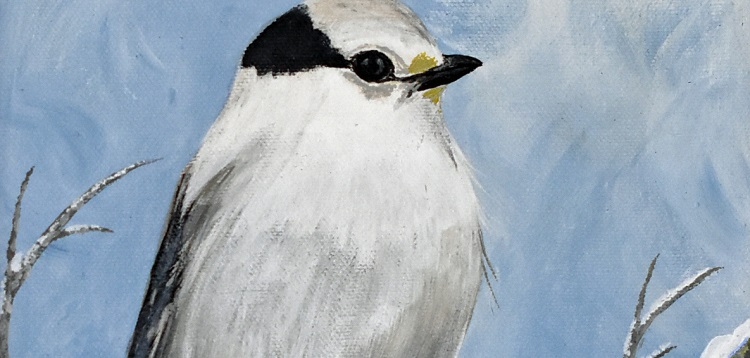
A Canada Jay male (left) and female by Norma Van Alstine. (Images courtesy of Norma Van Alstine.)
Find Norma on Facebook here.
Don’t miss out on Doppler!
Sign up here to receive our email digest with links to our most recent stories.
Local news in your inbox so you don’t miss anything!
Click here to support local news
Great picture! That big black, inquisitive eye.
I see fewer of these birds now. Partially because I’m not in the bush as much as I once was, and also because they seem to be fewer or further north. The last time I saw a good number of them was when hunting or fishing out of the ToGaRoKe camp on Lake Mozhabong.
My Dad and Gramps referred to them as ‘whiskey jacks’ or ‘meat birds’, and incursion into their forest would bring them tumbling through the air, curiosity piqued. They always seemed to be put together of loosely fitted parts.
The crack of a rifle would stir them to search you out; that big, black eye always inquiring “What’s in this for me?” They would pick through anything left from field dressing game, and some old-timers knew them as ‘meat birds’.
My uncle George had a friend who told us of having been in the bush cutting wood. One bird hung around while he was working, but really zeroed in when he stopped for a break. It fluttered in close, and when it was offered a piece of sandwich, gratefully accepted.
“They are greedy though” the man said.
“I turned to pour some tea, and the darned thing poked its head through the hole in my donut, grabbed the rest of the sandwich, and flew off into the alders!”
Hence another nickname for the bird in the painting.
Camp robber!