

As the 2018 budget discussions begin, councillors have balked at the suggested guideline for next year’s tax levy increase.
The Town’s Manager of Finance/Treasurer Julia McKenzie presented a report with the 2018 Budget Guidelines at the July 26 General Committee meeting. The guidelines were developed by the Budget Working Group, comprising Mayor Scott Aitchison, Deputy Mayor Karin Terziano, Councillor Brian Thompson, Town CAO Denise Corry, Director of Development Services Derrick Hammond, McKenzie, Director of Community Services Kari Lambe, Director of Operations and Protective Services Steve Hernen, and Director of Corporate Services Yvonne Aubichon, after consultation with Town departments.
The guideline brought forward by the working group is a 6.67 per cent increase in the levy for 2018, which represents a budget increase of $899,806. Of that increase, $265,161 is for operations, $400,000 will fund new roads capital projects, and the remaining amount will be applied to the Town’s Capital Asset Management Plan.
McKenzie said that a 6.67 per cent levy increase would result in an increase in the Huntsville portion of property tax bills of approximately 3.83 per cent. When the District and Education portions are added, that number would drop to 1.41 per cent thanks to a decrease in the Education amount for 2018, which is being transferred to the provincial tax base. A house valued at $246,000 would see an increase of $34/year.
But that number didn’t sit well with councillors, including some members of the working group.
“At budget subcommittee, we discussed this 6.67 and it was not a number the council portion of the committee was most favourable to. The staff portion of committee thought it was pretty workable,” said Deputy Mayor Karin Terziano. “To me, if we need to increase our budget $900,000 every year, which historically is what seems to be happening, I think we are getting outside the boundaries of what we are responsible for doing… the fact that we’ve increased taxes between six and seven per cent the last three years, if there is any catch up to be done, it should be done by now.”
She added that the increase residents will see on their tax bills varies based on assessed value, and that “on the District side, it’s based on tax-supported budget but there’s a huge percentage of the population that is affected by the rate-supported budget which is water and sewer and garbage, and that drives your taxes up that much more and that’s not being factored in; 6.67 isn’t a number I’m willing to settle with.”
Councillor Bob Stone said he’d like to see the levy increase drop to somewhere between four and five per cent.
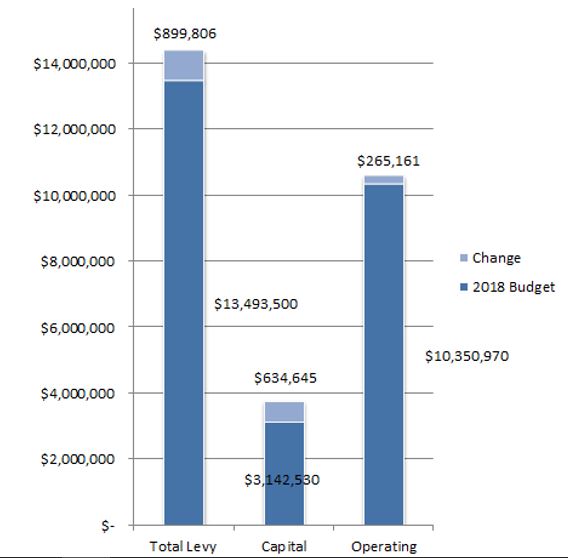 While Mayor Scott Aitchison said he is anxious about the increase as well, he pointed out that the capital increase is for roads, which residents have indicated they want to be a priority, and to fund the Capital Asset Management Plan, which is required by the Province.
“To me this really comes down to the capital infrastructure plan. If you look at the increase, the biggest chunk is in capital,” said Aitchison. “I commend this council. One of the things we have done well, even if we are criticized as being a do-nothing council, we didn’t build the summit centre, we didn’t build the theatre, we didn’t build a park, but what we have done is listen loud and clear to the constituents who said ‘just fix the roads’. So we’ve more than doubled our capital spend on roads. That’s what we should be doing.”
He noted that the Capital Asset Management Plan still won’t be fully funded following the next budget cycle, and that council could take some time to update the plan.
“I think we are doing very well at keeping this operation as lean as possible, we have fewer people on the sunshine list than we have in over a decade,” said Aitchison. “There’s nothing saying we can’t take a bit of a breather on getting that Capital Asset Management Plan up to 100 per cent, and maybe we step back and take a look at it, see the assets that we have in fact been able to get rid of through great pains and controversy, and look at other assets that maybe we need to get rid of. So we say we’re going to give the taxpayer a bit of a break this year, do some analysis and see which assets we actually want to fully fund, which we want to get rid of, and maybe also identify those assets we’re not going to fully fund with tax dollars, that we’ll plan to borrow money to replace it if we have to.”
The Town expects to receive $370,000 from new property assessments in 2018, which Aitchison noted would more than cover the operational increase – which maintains the status quo plus covers mandated increases like the minimum wage hike – and he said he’d like to see the capital increase limited to the equivalent of inflation. “I’m convinced the growth we are experiencing in Huntsville would more than pay for the growing cost of the operation.”
“I’ll put it out there,” he added to laughter from councillors. “You don’t want to increase taxes six per cent in an election year.”
McKenzie clarified that assessment growth isn’t included in calculating the levy increase, and said that “if we reduced our spend by $300,000, that would bring us to a tax increase of 1.66 per cent for the Huntsville tax rate.”
CAO Denise Corry added, “For a reduction of hundreds of thousands of dollars, a reduction in capital is where we are going to have to start.”
And the biggest capital projects are in roads. “If we are talking 200 or 300 thousand dollars, we are talking a roads project, and we have $16 million of immediate needs roads projects that need to be done now according to our roads needs study,” said Hernen. “We are putting three million a year in, and we are aggressive to be sure we are spending the full three million.”
To give councillors more time to consider the numbers, and for staff to provide details on what an inflationary increase would look like, the matter was transferred to the next regular council meeting at the end of August.
Don’t miss out on Doppler! Sign up for our free newsletter here.
I often wonder in amazement how our mayor and council can get away with the recent increases in taxes, an outrageous 21% for the last 3 years, with hardly a peep of opposition from us. And can you believe it, there is talk of another 7% for next year. I have been told by my councillor that of the increase for this year, 5.1% of this was required to maintain the status quo so the Town could operate.
I believe this council should attempt to explain why it has been necessary to increase the budget by close to 1 million dollars annually in recent years. What brought this on? Was it the increases in staff and salaries, the interest on loan payments or perhaps the frivolous spending that played a major part, not to mention the giveaway of assets. There is no question that very little consideration and importance has been given to the impact on struggling young families or pensioners on fixed income.
Relating to the roads issue, it is not comforting when visitors from Orillia and other towns say “and we thought our roads were bad”. Previous administrations including the current one, have approved funds for discretionary and/or less important budget items instead of allocating these required dollars to roads. This along with increased staffing salaries and spending in other departments only serves to exacerbate the problem including the hiring of a $100k plus salary for a Roads Director last year. Might it be that there are simply too many people in town hall making far too much money.
Of course the easy way out is to increase taxes and blame it on roads as this administration has done instead of seriously tackling these free spending issues and assessing the value of budget-draining, losing ventures. In the meantime, everyone’s back is patted for keeping this operation as lean as possible. What a joke!
Next year, how about an increase tied to the rate of inflation with an increase in funding for roads as a result of reviewing existing plans or services that may have to be curtailed including reductions in staff, at least temporarily if not permanently, until the roads dilemma is properly addressed. What a splendid idea if I must say so myself.
When this suggestion was posed to my councillor, the response and probably that held by most of council since it hasn’t been considered, was that the only way to increase the roads budget is to raise taxes. What a shameful response. I’m not asking for a great amount of creativity here but please remove the blinders! Doesn’t anyone want to stand up to be counted, dig in and consider us by rejecting these ridiculous tax increases? Apparently not.
Does this not provide a clear signal regarding the direction of this council? We as Canadians unfortunately will not “Storm the Bastille” or Town Hall as the French or New Yorkers might, but please think about this come election time, even when the tax increase is purposely and strategically minimized.
$34 is a small price to pay compared to the cost of repairing the damages to your vehicle every year because of the potholes and bumps you’ve hit. It’s time to start doing those infrastructure repairs we have been talking about but neglecting for years. I applaud the budget committee and say, ” Let’s get on with it!”