
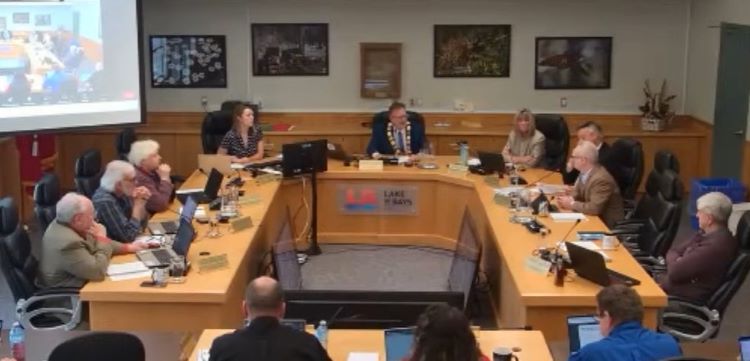
Lake of Bays municipal staff brought forward a report at the May 14 council meeting as per council’s previous direction.
Staff noted that they had prepared a preliminary list of all accommodations to which a Municipal Accommodation Tax (MAT) could be applied.
“At an 80% occupancy rate, hotel, motel, lodge, and inn revenues are estimated at $ 6.1 million. At an 80% occupancy rate, STR revenues are estimated at $35.9 million. A MAT charged at the rate of 4% would result in additional annual revenues of $1.68 million to the Township of Lake of Bays,” noted the report.
Staff is expected to return to council with a draft bylaw and procedures to support the implementation of a new MAT program for the Township of Lake of Bays.
Don’t miss out on Doppler!
Sign up here to receive our email digest with links to our most recent stories.
Local news in your inbox so you don’t miss anything!
Click here to support local news
A writer above said, “If hundreds and hundreds of Muskoka cottages are taken out of the long-term rental market and converted to “Air B n B -type rentals, where will local citizens and workers live?” That question is absolutely wrong in its assumptions.
Local citizens and workers don’t, and never will, live in waterfront cottages. These cottages are Summer Homes used by city people looking to get away from the concrete and engine roar for a few weeks of the year. They have no intention of putting long term renters in there. That would mean the owners couldn’t come up for a summer holiday.
The reason owners rent out their waterfront cottages for a few weeks in the summer is to have some extra cash to pay their very expensive local property taxes. I would remind you that those high waterfront taxes contribute to the area’s well-being, that would otherwise be difficult to run a municipal government.
Most of the owners of cottages that are being rented out to summer visitors are very careful to limit the numbers, set the rules, and monitor the activities. Rental agencies do this even more, and do it better, due to long experience.
If you drive cottage rental out of the area, you lose in 2 things: you will lose a lot of local visitors who bring dollars into the area; and you lose those cottages to off-shore investors and developers who only want to make profits out of property turn-around.
The MAT is long overdue and city’s need it to pay for services they need to provide–> right now, they are using other means to fleece taxpayers that make no sense. We are on a class 6 highway (single track, seasonal dirt road with less than 49 vehicular traffic per day) and the township is requiring the 10 cottages on Pine Lane (Chub lake): (1) Pay for a complete road survey, (2) pay yearly for a license to use the road, (3) purchase $5 million in insurance for the road allowance, (4) assume responsibility for upgrading the road to their standard (as yet undefined–but possibly to make it dual track!!!). We were given notice of this late March and are being threatened with thousands in fines if we don’t comply. Meanwhile, the one person commercializing their cottage on our road into an airbnb ($450 a night) and who has fast-tracked the initiative for us is the only one with the financial means to pay for all this–nobody else does. If you are making money from your property, pay your share and please don’t expect other taxpayers to pay your share for you. More information here: https://cottagelife.com/general/lake-of-bays-threatens-trespassing-charges-for-residents-who-refuse-to-sign-road-access-agreement/
I agree whole heartedly in the phrase “ 80 % occupancy “assumption” that the Committee is apparently basing its recommended Municipal Accommodation Tax (MAT) on is so far from reality, it calls into question the validity of that Committee’s work as a whole.“
Muskoka spend a lot of money to commission the 128-page PKF Report on tourism in 2013.
The Lake of Bays Committee should have read it. Or, if they read it, why did they ignore it?
80 % occupancy “assumption” that the Committee is apparently basing its recommended Municipal Accommodation Tax (MAT) on is so far from reality, it calls into question the validity of that Committee’s work as a whole.
Muskoka has had a problem with year-round occupancy in tourism since the beginning.
Please refer to the PKF Report, 2013, page 76:
“The Muskoka Resort industry is currently suffering … with 87 resorts.3200 rooms achieving an annual market occupancy of under 50% and as low as 30% in the winter and spring periods.”
Does the Committee believe those percentages have somehow dramatically risen to 80% in the past decade ?
Since their assumption is completely unrealistic, then why are they being so dramatic? The answer must be that the new tax will raise a lot of money.
The short term rental industry which is overtaking the resort industry in Muskoka in terms of the number of bedroom being rented is included in the new MAT tax. That is logical.
However, a much more significant question should be asked: If hundreds and hundreds of Muskoka cottages are taken out of the long-term rental market and converted to “Air B n B -type rentals, (which is the case now) where will local citizens and workers live?
For reference, compare the evolving Muskoka situation with that of, for example, Canmore , Alberta. There, local citizens cannot afford to buy a home and there is nothing affordable (or available) to rent long-term.
Currently, in Muskoka, resorts and restaurants are busing workers up from Barrie and Toronto.
This long-term social issue is, in my opinion, very important. It has significant implications for the social cohesion of our community. We risk have a “hollowed-out” community which excludes some citizens.
I can suggest two possible paths towards improving the situation:
first, cap the number of licenses for Short term rentals . Bracebridge has already chosen 4% of housing as a cap. If that were applied across Muskoka, it still represents a lot of homes not available for local residents and workers. But it would cap the problem.
Second, District should lobby the provincial government to fix the Landlord Tenant Act. It is still broken and seriously impedes long-term rentals being offered. The problem is so bad that even the recent government’s doubling of adjudicators has hardly made a dint in the problem.
A healthy community surely is one in which citizens , certainly all Canadian citizens, can attain a home, whether they rent it or whether they purchase.
David Scott
owner
Clyffe House Resort, Port Sydney.
“since 1886”
Can the tourist business in Lake of Bays stand this tax? Are some of the resorts still suffering from lack of business caused by covid? Maybe the township should tell staff to find 4% savings in efficiencies. I am thinking that resorts already pay tax to the township.
Regarding the 80% occupancy rate estimate.
I have read things like the Lord of the Rings and some Star Trek and I have to admit that the L of B estimate of occupancy lies right up there near the top of the fiction category.