
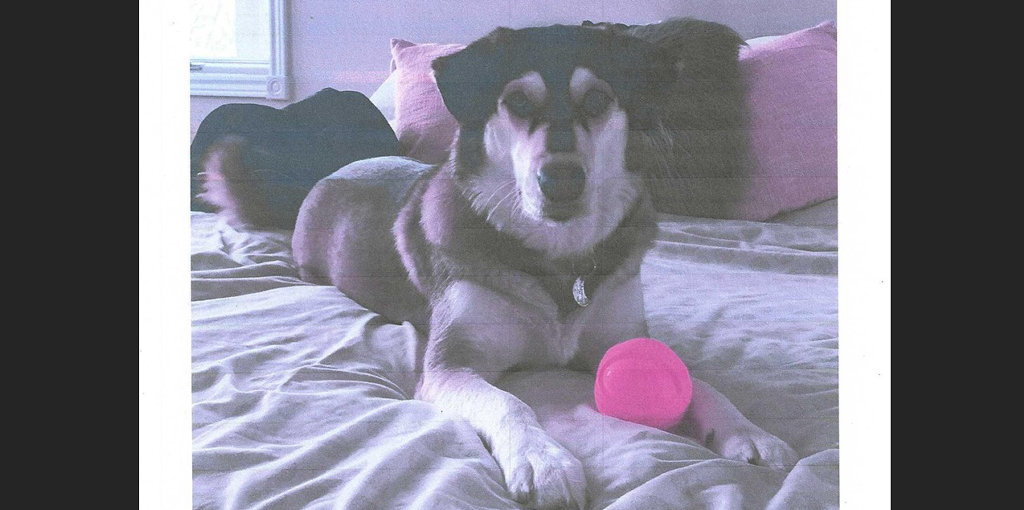
Further to a story we brought you on May 24, Huntsville Council to decide whether to lift order to muzzle dog, Huntsville Council heard from both the owner of the dog and the plaintiff and, after deliberating on the situation, opted to have the muzzle order remain.
The plaintiff said the dog had also attacked another dog, but that claim was not substantiated at the meeting. She said she is afraid to walk down the road and asked council to uphold the order to muzzle the dog.
“No one should be nervous walking down the streets of Huntsville,” said Huntsville Councillor Bob Stone.
The defendant said the muzzle order is a great injustice. She provided a petition with signatures all vouching for the dog and stating that the dog is not a threat to public safety. She said her dog, Nova, was one at the time of the incident and had already lost two years of her life under a muzzle order and asked that council give her dog a second chance. “Even those people who are imprisoned are allowed a second chance,” she said.
Council heard the dog lives in a condominium without a private yard, so a muzzle order means having the muzzle on at all times while outdoors.
Deputy Mayor Dan Armour asked if the dog had had any formal training, to which the defendant responded that she had been trained by herself and her daughter. Armour suggested that a professional dog trainer might be able to work with the dog, assess her, and bring the findings back to the council. The plaintiff said she would consider that but said she didn’t think a trainer would know her dog better than the people who signed the petition.
Councillor Monty Clouthier said prisoners also get counseling while they are in jail “so that they can get out and be responsible citizens when they do.” He said he’s had dogs his whole life until the last few years. He said he thought the dog should be evaluated by a professional. “I think we’d feel a lot more comfortable making a decision…”
Councillor Scott Morrison said the decision is one of the toughest he’s had to make. He said he has two beautiful big dogs; they weren’t the best when they were puppies. “They’ve definitely improved, and muzzling my dogs would feel unfair.” He also said a dog belonging to a good friend was great with him but ended up putting its teeth through another friend’s hand and had to be put down. He said the dog is beautiful but if the dog were to bite or attack someone if the muzzle is lifted, he would have a tough time sleeping at night. Morrison said he wished he could take the dog home and give the dog a yard to play in.
Huntsville Councillor Jason FitzGerald said the decision was causing him great grief because he has two rescue Huskies at home, and one looks exactly like the dog Nova, the Husky/Golden Retriever Cross who bit another dog and whose owner was ordered to muzzle her.
“The dogs fight; they’re best friends, and they give each other puncture wounds playfighting,” said FitzGerals of his Huskies. “The big Husky, a boy, I can’t take him off the property because he is aggressive, and I know that, so I don’t. We got the other dog to keep him company, and they have a great area to run through and play. So as much as I want to say yeah, remove the muzzle, in good conscience, I can’t.”
Bylaw Enforcement Officer for the Town, Corey Crewson, was recommending that the muzzle order remain. He also said upon consulting with the Risk Assessment Coordinator, the resulting advice was that the muzzle order remain in place.
Councillor Cory Clarke said lifting the muzzle order is not worth the risk. “My greatest fear would be that there’s a small child or somebody that is injured severely, so it’s just not worth the risk, in my opinion.”
In the end, the majority of councillors (except Armour) voted to keep the muzzle order in place.
Don’t miss out on Doppler!
Sign up here to receive our email digest with links to our most recent stories.
Local news in your inbox so you don’t miss anything!
Click here to support local news
Re: Addressing the Muzzle Order Decision: Expert Insights from a Canine Psychologist
As an award-winning, multi-certified international canine psychologist and behaviourist, I have dedicated my career to addressing persistent and complex behaviour challenges in dogs, achieving a remarkable 98% success rate year over year. Based in Huntsville and working across Canada, I feel compelled to offer my insights on the recent decision by the Huntsville Council to uphold the muzzle order for Nova, a Husky/Golden Retriever Cross.
Aggression in dogs is often misunderstood. It is rarely driven by malicious intent. Evolution has hardwired dogs to seek cooperative behaviours crucial for their survival. When a dog exhibits aggression, it is typically a response to perceived threats rather than an inherent desire to harm.
One or two isolated incidents should not be taken as an indication of a dangerous pattern. Behaviour in dogs is shaped by a multitude of factors including age, genetics, health, past experiences, socialization, and environment. It is essential to understand that behaviours can and do change over time.
We must also consider the limitations of dogs’ emotional control. While dogs share some similarities with humans in brain function, their executive function—critical for self-regulation and decision-making—is not as developed. This means dogs often struggle to control impulses, especially when they come from challenging backgrounds. Impaired executive functions in dogs who’ve had a poor past are reversible, allowing for greater emotional control.
The assumption that Nova is likely to repeat the offence lacks solid evidence. Patterns of dangerous behaviour are complex and require more than anecdotal opinions to be established. Modern research provides indicators that should guide such important decisions.
A muzzle should not be seen as a punitive measure. With the right training and positive reinforcement, a dog can learn to wear a muzzle as comfortably as a harness or collar. This process heavily depends on the caregiver’s approach. Introducing a muzzle positively can enhance the quality of life for both the dog and the caregiver.
Councillor Monty Clouthier’s suggestion of professional evaluation is crucial. A qualified canine behaviourist can offer a thorough assessment, providing insights that can inform more balanced decisions. It is essential to base such decisions on expert evaluations rather than fears or assumptions.
I deeply empathize with the fear experienced by the caregiver of the attacked dog. However, controlling every potential trigger for trauma in a community is not practical. Trauma manifests in various ways, and it is unrealistic to expect all triggers to be managed externally. A muzzle on a dog who is indeed a repeated offender will not stop the dog from physically damaging another dog or human. My experience is some of the worst cases of dog aggression have seen muzzles causing massive bruising and deep lacerations from nails of a dog severely frightened and choosing to fight to survive. This is why we need to be careful with muzzle orders, recognising their limitations and restrictions especially in light of making decisions to mitigate human trauma and feelings of safety.
Dogs have been integral to human society for millennia, becoming more embedded in our lives over time. It is imperative for policy-makers to rely on current scientific evidence rather than outdated beliefs. The rapid advances in dog psychology and behaviour research over the past few years highlight the need for continual learning and adaptation. Muzzle orders should be applied judiciously and based on comprehensive evidence. Embracing evidence-based science ensures more effective and humane solutions for our canine companions.
All the best,
Sparky Smith, MSST, ISCP.DIP.CANINE.PRAC., IAABC – CDBC, MCMA, SSBB
Awards: Finalist Change Innovator Award 2024, Pet Psychologist of the Year 2022 | Human-Centric Canine Psychologist 2022
Head Canine Psychologist and Behaviourist, PivotalChange.ca
Founder, Dog Parentology™
(She/Her)
I’m glad the muzzle remains. You can’t trust a dog that has bitten. It won’t hurt the dog to wear muzzle when out in the streets and remove it when dog is in own yard or home. Seems fair.