
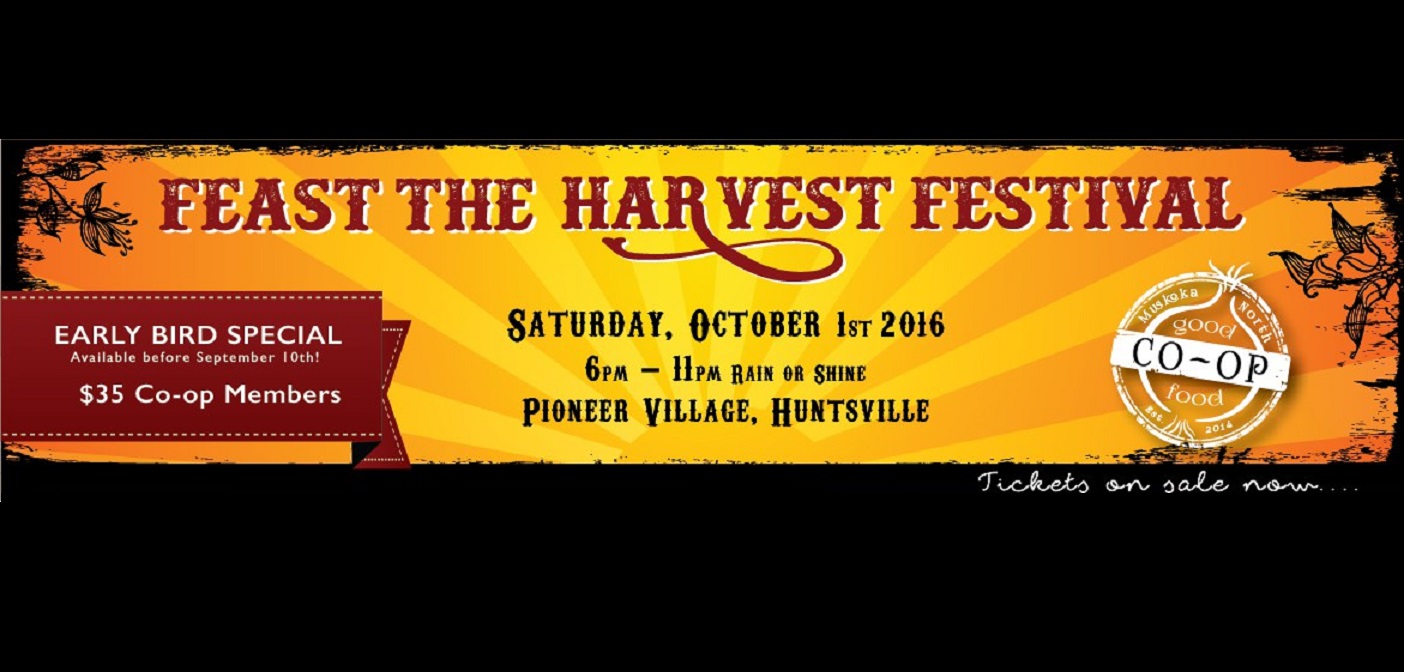
Do you care about what you eat? If you like good, fresh and local when it comes to your food and you’re hoping to be awed by the number of food producers in Muskoka, then you won’t want to miss Feast the Harvest Festival at Muskoka Heritage Place this Saturday, from 6 to 11 p.m.
The family-friendly event is wheelchair accessible and is being put on by the Muskoka North Good Food Co-op. Tickets are $45 per person or $40 for co-op members. Tickets for youth 13 to 18 are $20 and kids 12 and under get in for free.There will be local food, a cash bar with local craft beer and cocktails made with special infusions from local plants. There will also be music with special guest Denis Gauthier and special activities for the kids. For more information about the co-op, to become a member or to get tickets to this Saturday’s event, check out the co-op’s website here.
What is Muskoka North Good Food Co-op?
The Muskoka North Good Food Co-op started almost three years ago as a grassroots initiative by a group of like-minded individuals led by Kelli Ebbs. The group’s vision was two-pronged: bringing better access to clean, local and sustainable food to Muskoka while encouraging local food producers to grow and produce more food by providing a more reliable market in which to sell their food. Following numerous consultations the group came up with the concept of a community-owned food store “where farmers are getting fair value for their food and consumers are getting that food at a fair price, so that we can make it as accessible and inclusive as possible,” explained Ebbs. The group became incorporated as a not-for-profit co-operative and now has over 600 families who hold a membership.
Our goal is to create a high-level food economy in our region through a co-operative food market. Muskoka North Good Food Co-op General manager Kelli Ebbs
The co-operative has been quietly working away, building momentum, creating support for its concept, networking, educating and raising funds. “It takes time to build a co-op. You have to have an educated public. People have to know what they’re buying into and really believe in it,” said Ebbs. She said the demand for the concept and support has been amazing. The co-operative is never short of volunteers willing to roll up their sleeves and get to work. She said she’s amazed by the diversity of the people involved because everyone needs access to food that they can trust and “they’re ready for it”.
How will they fill their shelves during winter?
Ebbs said in seasons when certain food is hard to find, the co-operative has been establishing connections and plans on filling the gap with food from other co-operative ventures. There’s a co-op of Mennonite organic farmers in southern Ontario. “So we’ll go and reach out to them when we need to put peppers and eggplants on the shelves in February and we’re going to keep the stream of food as healthy and safe and sustainable as you would see in the middle of summer.”
How far along are they?
Ebbs said plans are underway within the next couple of months to begin creating the first 3,500 square feet of the food market, which will be located at 1 Crescent Avenue in Huntsville’s west end. The market will include a commercial kitchen – giving food producers an opportunity to create value-added products – as well as a café.
“We have some pending grant applications and we’re waiting to hear how those do and in the meantime we’re taking our busload of volunteers and we’re going to start knocking down walls and start building,” she said. “If it means that we’re using used fridges and freezers for the first year while we start building a clientele and start getting the ball rolling, then that’s what we do because it’s essentially really just about getting food to people.”
Ebbs said the food co-op will have strict procurement policies, so just because something is grown in Muskoka does not mean they’ll carry it. “We scrutinize everything for the sake of everybody’s health and well-being and we’ll also help farmers who aren’t quite making the cut, we’ll help them get there,” she said, adding that the co-op’s first procurement priority will be Muskoka and northern Ontario – reaching as far out as Thunder Bay and Dryden and anywhere in between.
“It is unbelievable what kind of agriculture exists in the north of Ontario and the beauty of it is northern Ontario is a clean place still. We know the cattle are eating clean grasses, the chickens are being fed clean water – we’re kind of out of that southern agriculture climate, I guess, of heavy chemical use and not-so-safe water. We’re really lucky on that level being where we are.”
So what does Muskoka produce?
Lots, said Ebbs, especially meat. From lamb and beef to chicken and trout – there’s lots of it. “That is great because when we surveyed our members we asked what their top priorities were for food choices and meat was the number one. They’re really wanting clean, safe meat.”
She also said there’s an amazing assortment of locally grown root crops like carrots, turnips, and parsnips, as well as potatoes and garlic, squash, onions, and mushrooms such as Shiitake. There’s also locally produced honey, maple syrup, and value-added food such as preserves. Ebbs said the co-op is also working closely with bakeries to use flour that is not derived from genetically modified grain in their baked goods. “We’ve managed to get them access to organic cane sugar and organic flours and talk more about wholesome baking and incorporating the more wholesome ingredients and they’re doing it and it’s just amazing.”
Don’t miss out on Doppler! Sign up for our free, twice-weekly newsletter here.
0 Comments