

This Listen Up! guest post is by Hugh Holland. Hugh Mackenzie is taking a break from Listen Up! at the moment.
By Hugh Holland
If climate change is the biggest threat to the future of our children and the planet, how can Canada best contribute to the mitigation of climate change? The following SWOT analysis shows a concise summary of our Strengths, Weaknesses, Opportunities, and Threats.
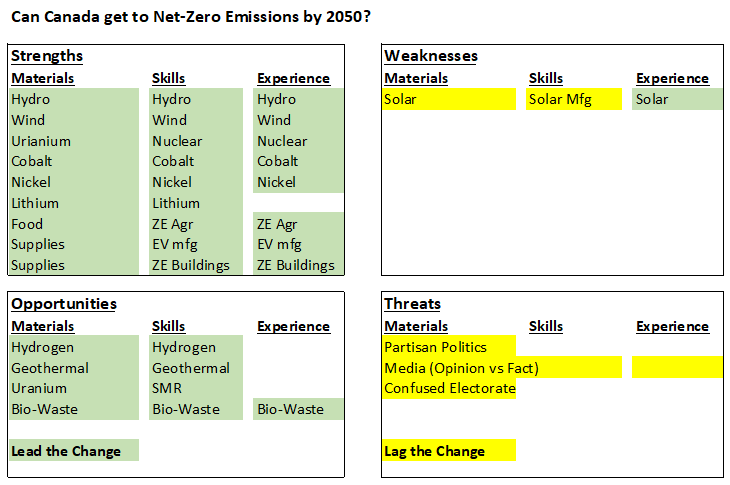
The chart shows that Canada has abundant Strengths, many Opportunities, few Weaknesses, and few Threats, and can indeed, over the next 30 years, replace carbon-based fossil fuels with a diverse and stable mix of clean energy. Take nuclear for example; we have the raw materials, we have world-class nuclear skills, and we have 60 years of positive nuclear experience.
In terms of Weakness, solar can make an important contribution, but Canada is not one of the world’s solar hotspots and China already dominates 95% of global solar panel production.
The biggest Threats to the mitigation of climate change are not technical. In issuing its Net-Zero Emission Roadmap, the International Energy Agency said, “The good news is we know what we need to do – and how to do it. But strong national and international cooperation is crucial to success”. The biggest threats are still partisan politics and media that have become more focussed on controversial opinions than on verified facts. FOX News and Facebook demonstrate that controversial opinions generate engagement and engagement generates huge profits. Misinformation and partisan politics combine to make a confused electorate and slow progress.
Beliefs are changing, but the far left still has an irrational faith in wind and solar energy and an irrational fear of nuclear. Spain is the world leader in solar, but solar is only 4% of Spain’s energy supply. The far right has had an irrational belief that 8 to 9 billion people can somehow muddle through indefinitely on finite supplies of fossil fuels, without adding to the climate crisis.
The tricky part is managing the short-term threats and long-term opportunities at the same time. Oil and Gas companies say if they stop producing oil and gas before consumers (That’s us) stop consuming it, resulting energy shortages will only add to our problems.
The International Energy Agency says that global demand for oil and gas will peak in 2030 and that existing sources can provide the diminishing quantities required until 2050. The far left says we should build no new pipelines, period. But obviously, as smaller oil and gas reserves are depleted, transportation infrastructure must be adjusted.
The truth is every country needs a moderate middle-ground approach to transition rapidly from fossil fuels to their own unique and diverse mix using every type of clean energy. History and political science tell us the way to reduce political polarization is to elect people who treat opponents with respect, so that together they can look for common ground and sensible solutions. In other words, without political and industrial statesmanship, we are doomed to fail.
Our “Oil & Gas companies” have the skills needed to reduce their emissions in the short term and to gradually re-invent themselves over the next 30 years to become valuable “Clean Energy companies”. Canada has more than enough oil and gas to last as we work our way through the 30-year transition to clean energy, but many others (e.g. EU and USA) do not. So, our Ministries of Energy and Environment are navigating this complex global situation by supporting two new pipelines, and by using both the carrot and the stick to reduce our own emissions.
Here is a positive example of what can be done. The Trans Mountain oil pipeline expansion was first proposed in 2013. After 5 years of protests and court challenges, it was finally approved in 2018. The CEO hired to plan and build the pipeline is a patient man with a lifetime of solid experience. He says he spent half his time walking the route, listening carefully to people’s concerns, and resolving most concerns, to avoid more protests and court battles. Some concerns were easy to resolve, and some were harder. Of course, that resulted in delays and will increase the final cost, but with court costs avoided and the outcome assured, and with current world conditions, the lifetime economics of the project are still very sound. After a nationwide protest in February 2020, the Coastal Gas Link pipeline builders took a similar approach. Both new pipelines are expected to be operational by mid-2024.
The so-called Ring of Fire in northern Ontario is a treasure trove of minerals needed for EV batteries and other aspects of reducing emissions. But Ontario’s James Bay lowland is also a huge globally significant peat bog, storing billions of tonnes of carbon dioxide. The local people want infrastructure and economic development, but they are working with an environmental group calling for a moratorium on industrial roads and mining until the parties can determine what actions are required to ensure that the number of emissions released does not exceed the number of emissions avoided by the minerals mined. That too should be possible. It will help that Canada is a leader in zero-emission mining technologies. The sooner all local, expert, and government agencies, and political parties can cooperate in good faith, the sooner responsible decisions will be made. Considering what is at stake, is that too much to ask?
Hugh Holland, Oct 15, 2023 Reference – What’s at stake in Ontario’s Ring of Fire | Canadian Geographic

Hugh Holland is a retired engineering and manufacturing executive now living in Huntsville, Ontario.
Don’t miss out on Doppler!
Sign up here to receive our email digest with links to our most recent stories.
Local news in your inbox so you don’t miss anything!
Click here to support local news
So alarming that the constant self-gratifying barrage of proven unscientific and false climate change alarmism from Hugh Holland is given a voice in Huntsville Doppler. So obviously an enabler of Justin Trudeau’s agenda to use his “Save the Planet” agenda to destroy our country’s economy and accordingly open the door to the WEF’s and UN’s Great Reset, the removal of democracy, sovereignty, rights, and freedoms.
A few points for Bob. Your comments on power, and particularly on demand are not correct. Electricity demand forecasts by most energy system experts show Canadian demand doubling or trippling to reach net zero by 2050. Further, there is no viable solution today to replace that much power with wind/solar and massive battery-backup. The costs to build massive stored green hydrogen or pumped hydro gereration are prohibitively high as well. More conservation incentives would be helpful, but they won’t change the fundamentals.
If you want a real world example of a botched power system, look at Australia. They now have the highest power cost and most volatile in the industrialized world. Their electricity cost now averages 2.5x ours. They are also experiencing power instability, and their energy regulatory now warns of power blackouts ahead. Bad planning is the reason, including moving far too rapidly to wind and solar, which recently accounted for a record 39% of all power generated.
No thanks, we don’t want follow their path.
“New Solar + Battery Price Crushes Fossil Fuels, Buries Nuclear”
“Los Angeles Power and Water officials have struck a deal on the largest and cheapest solar + battery-storage project in the world, at prices that leave fossil fuels in the dust and may relegate nuclear power to the dustbin.”
Instead Ontario is going backwards under Doug Ford.
“Doug Ford government wants new gas plants to boost Ontario’s electricity system”
Conservation of energy has the same effect as new generation for pennies on the dollar. Much cheaper than new generation from any source.
There was no reason at all for Doug Ford to cancel all the money and energy saving rebates.
None.
It appears some have no idea how inexpensive conservation of energy was/is or how effective it is to avoid new generation.
For example “A Heat Pump Water Heater Will Save All The Electricity You’ll Need To Power Your Electric Vehicle” compared to electric resistance water heaters so no new energy would be needed for EVs.
In the US after federal, state and utility rebates they are the least expensive type to buy and, by far, the least expensive to operate.
If Canada was serious about net zero we would have matching rebates like the US.
Power demand in Ontario was going down for 12 years 2005-2017 in spite of the population going up due to Save On Energy and other conservation programs.
Ford cancelled all of them in 2018 so demand is skyrocketing requiring billions in new generation.
Maintain existing nuclear and add solar, wind, storage and energy conservation is the way forward.
Storage is also inexpensive compared to new generation. Especially new nuclear.
Many areas are replacing GHG spewing natural gas peaker plants with battery and other storage types.
For example “Gravity batteries: Abandoned mines could store enough energy to power ‘the entire earth’”
“turning decommissioned mines into vast “gravity batteries” could provide up to 70 terawatts of energy storage. This is enough to match the entire world’s daily electricity consumption.”
New nuclear is simply too expensive.
Whatever the estimated cost for nuclear is double it.
Whatever the estimated timing is double it.
“Georgia nuclear rebirth arrives 7 years late, $17B over cost.”
Some cities in the US are bailing on the first SMR project due to increased costs and delays.
Search “Shakeup for 720-MW Nuclear SMR Project as More Cities Withdraw Participation”
Decommissioning existing nuclear is also too expensive.
At end of life you can either spend billions to refurbish existing nuclear and produce a massive amount of power for another 40 years or so or spend billions to decommission and not get a single kWh.
Refurbishment of existing nuclear it is.
Some comments here show lack of understanding of how power systems actually work. As Hugh clarified, the intermittency of wind & solar make it unsuitable to deliver baseload power. It also makes it unsuitable to replace gas peaked plants. As Ontario’s IESO (agency that oversees planning of our power system in Ontario) detailed in a recent report, just the capital cost to replace the gas plants with wind/solar and batteries exceeds $400 billion (by 2050) & likely double electricity cost in the pricess, and would not even guarantee reliable power.
Doug Ford’s decision to keep and now expand gas plants, and invest in nuclear ( especially SMR’s) was needed to ensure we have reliable and affordable power in the years ahead. With the Nuc refurbishments taking some baseload power off line over the next decade, there was no other viable choice. As our population grows and more is electrified, power demand is rising significantly.
Ontario residents and businesses don’t want high cost, unreliable power.
Ontario used to be 96% non-fossil fuel power. Now it’s down to 90% and dropping fast due to Doug Ford’s many mistakes.
He cancelled 750 green energy projects, already under construction, and wasted hundreds of millions of taxpayer dollars. At the time he claimed Ontario didn’t need the power.
Now he’s spending billions on new GHG spewing natural gas power plants instead.
The City of Thorold blocked one of the new plants for environmental reasons.
No kidding.
Conservation of energy has the same effect as new generation for pennies on the dollar.
Power demand in Ontario was going down for 12 years 2005-2017 in spite of the population going up due to Save On Energy and other conservation programs.
Ford cancelled all of them in 2018 so demand is skyrocketing requiring billions in new generation.
“Doug Ford government wants new gas plants to boost Ontario’s electricity system
Even if federal regulations shut down gas-fired facilities, province will keep paying power contracts”
Higher energy usage, higher energy bills and higher emissions due to Ford’s many mistakes.
Jim, there is indeed and important place for wind and solar energy, but to get to net-zero emissions, all countries need to use their own unique mix of wind, solar, hydro, energy-from-waste, big nuclear, small nuclear, and geothermal. Wind and solar are highly intermittent by time, season, and region. Annual solar output is 3 times higher in places like Spain, the Middle East, California, and Australia than in Ontario. The latest report from the US Energy Information Authority shows that wind and solar costs have come down and are now the lowest – – provided they can be used when they are produced, but when battery storage is required, wind and solar go from low cost to high cost. The cost of battery storage is going up due to supply chain constraints. Battery storage for wind and solar competes with EV batteries for minerals.
Ontario and Germany can make solar but are not solar hotspots. After 20 years of trying, solar is currently 1% of Ontario’s total energy supply and wind is 1.3%. That is very similar to results in Germany‘s similar climate. Solar takes a lot of space. To take solar up to 4% of Ontario’s energy supply would cover the equivalent of 1,350 average Ontario farms with solar panels. That compares with 30 farms for Doug Ford’s greenbelt homes, and we all know how that was accepted. Of course, there is more potential for rooftop solar but that would need Ford to reinstate McGuinty’s feed-in-tariff program.
Wind and solar output are counter-seasonal, so a balanced hybrid wind-solar module can produce a reasonably consistent year-round output, but still with wide variations from day to night. Diesel fuel is being replaced by green hydrogen. The best way to use intermittent wind and solar is to make green hydrogen by spitting water into H2 and O2 with an electrolyser using electricity from a hybrid wind-solar plant. The hydrogen provides the storage, so no battery storage is required. We need to optimize the use of all possible sources of clean, green energy.
I learned yesterday, that 92 percent of new power projects in the US are wind, solar and batteries. That is because it is the cheapest and safest way to produce electricity. It has the added bonus of being easily distirbuted, right to the home and factory level, there by eliminating any issues with the grid. The cost of solar and batteries has declined 80 percent in the last decade, and will contine to decline in the future.
It is not a political discussion, it is an economic one. The US is not a far left country, it is a country run by big businss. Business people will go for the cheapest solution, and they always have. It is not nuclear, it is solar and batteries, with wind to help when the sun doesn’t shine.
Ontatio’s problem is it’s power generation is highly political. Doug Ford, who knows nothing about energy generation, made his first official act to cancel all renewable energy projects. That was purely political, and economically ridiculous.
Sorry Hugh, the market does not agree with your analysis.