
BY JOHN COWAN
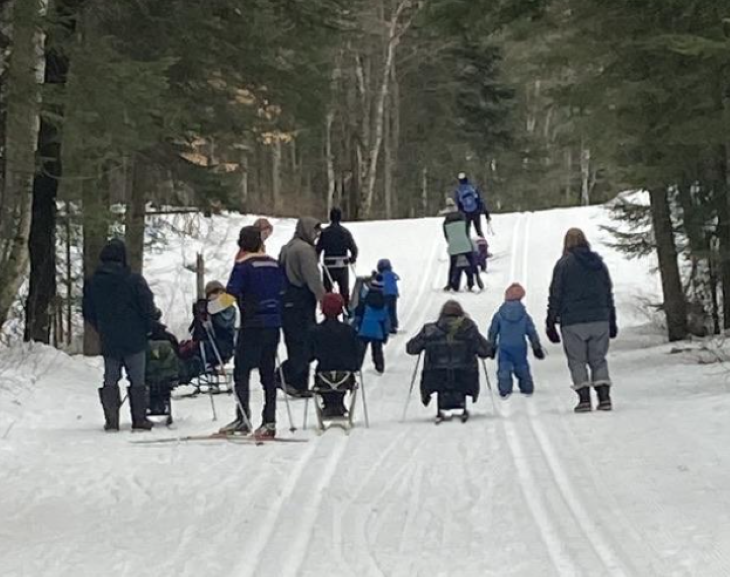
Arrowhead Nordic Ski Club successfully piloted the third level of the Eagle Para Nordic Skills Development Program (SDP) this past season on behalf of the Cross Country Ski Ontario Para Nordic Committee.
The Eagle Para Nordic Program is designed to provide individuals with acquired or congenital disabilities the opportunity to participate in and enjoy winter sports.
A key consideration within the program is the thoughtful and appropriate use of terminology. All participants in sport possess abilities. To support inclusive and appropriate programming, three participation streams are recognized: the Paralympic stream for athletes with physical disabilities, the Special Olympic stream for athletes with cognitive disabilities, and the Olympic stream for all other athletes. In some cases, athletes may compete across streams; for example, Canadian Paralympic multiple medallist Brian McKeever qualified to compete in the 2010 Olympic Winter Games.
At both the national and provincial levels, cross-country skiing offers strong high-performance pathways, enabling athletes to compete provincially, nationally, and internationally. Local athletes such as Collin Cameron, a Crystal Globe World Champion sit skier, and Nathan Perry, a multiple Canada Winter Games silver medallist, have progressed through this system. However, historically, there has been a gap in entry-level programming for individuals with disabilities. As recently as 2021, only one club in Sudbury offered a para Nordic program, largely driven by individual leadership.
That same year, a renewed effort began to establish a structured provincial approach. The Cross Country Ski Ontario Para Nordic Committee was formed to expand opportunities across Ontario and beyond. Early work identified three critical gaps: the absence of a standardized curriculum, limited access to safe and adaptable equipment, and a lack of coach education specific to para Nordic athletes.
The Eagle Para Nordic Skills Development Program was developed to address these needs. It is a three-year, progressive curriculum: athletes learn foundational skills in year one, refine technique and build confidence in year two, and explore advanced opportunities such as para biathlon, para orienteering, and competition in year three. Unlike traditional youth programs, the Eagle program has no age restrictions, recognizing that individuals may acquire disabilities at any stage of life.
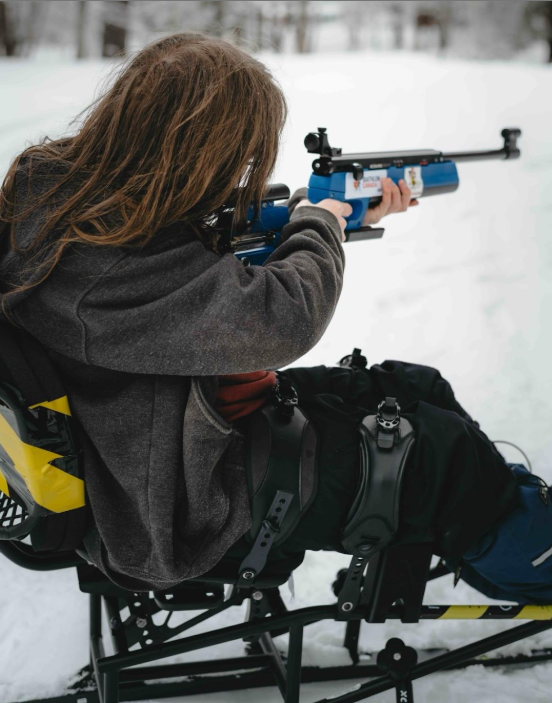
A major innovation within the Level 3 “Soaring and Exploring” program was the introduction of the EcoAims Optical Biathlon system. This advanced, non-projectile system uses camera-based technology to teach aiming and shooting skills. Participants learn proper sight alignment using front and rear sights, while real-time feedback supports skill development in breathing control, focus, and trigger execution. The system also includes an adaptive format for visually impaired participants, using auditory feedback to guide aim. Its reliability across all weather conditions and alignment with evolving international standards make it a valuable training tool. Both athletes and coaches responded enthusiastically to the added challenge and engagement. The Eagle Para Nordic program has been highlighted in newsletters by both Biathlon Canada and the International Biathlon Union, demonstrating the opportunities for inclusive sport.
Program development has been supported by research from the University of Alberta’s Steadward Centre for Accessible Sport, which provided tools to help clubs assess and improve accessibility in programming and facilities. This includes a practical evaluation framework that encourages continuous improvement beyond basic accessibility measures.
Equipment innovation was another major focus. Historically, para Nordic equipment was often custom-built for individual users, limiting scalability and safety assurance. To address this, partnerships were formed to source engineered, adaptable equipment capable of supporting a wide range of users. This led to collaboration with a Norwegian manufacturer to acquire versatile sit-skis and multi-surface training equipment. Funding support through Canadian Tire Jumpstart enabled the purchase of both on-snow and off-snow systems, significantly expanding program capacity.
The growth of the Eagle Para Nordic Program has been substantial. Over the past five years, participation has expanded to nine clubs across Ontario. Following a national coaching summit in 2024, the program has also been adopted in British Columbia, Alberta, Quebec, and Nova Scotia.
Arrowhead Provincial Park has played a pivotal role in supporting program delivery. The park is now home to Canada’s first designated and signed winter trail for adaptive sports equipment. Accessibility enhancements include dedicated parking, an accessible chalet, and wheelchair-height waxing stations. The park has also invested in adaptable sit-skis that can be used year-round, including on its skating trail through interchangeable blade systems.
A large thank you to the leadership at Arrowhead Provincial Park, including former superintendent Jason Crozier, acting superintendent Matt Gibson, and former acting assistant superintendents Steve Kearney and Maddie Austin.
The Skills Development Program serves as the foundation for the broader para Nordic pathway in Ontario. Athletes seeking competition can progress to the Ontario Development Para Nordic Team and ultimately the Ontario Ski Team, with opportunities to compete at Canada Games, national championships, and beyond. Parallel efforts are underway to expand para biathlon pathways in collaboration with provincial and national partners.
Progress is also being made in athlete support. Historically, para athletes did not always receive the same sponsorship opportunities as their Olympic-stream counterparts. Through local partnerships, Ontario Ski Team para athletes now have access to professional equipment support, helping to level the playing field.
The notable achievements of the pilot program were made possible through the dedicated support and guidance of the local community. Key figures in program leadership at Arrowhead Nordic included Madison Buck and Nick de Jong, both of whom played instrumental roles in guiding participants and offering valuable feedback that contributed to the ongoing development of the program.
Special recognition is also extended to the program’s local sponsors for their essential contributions.
Don’t miss out on Doppler!
Sign up here to receive our email digest with links to our most recent stories.
Local news in your inbox so you don’t miss anything!
Click here to support local news
0 Comments